
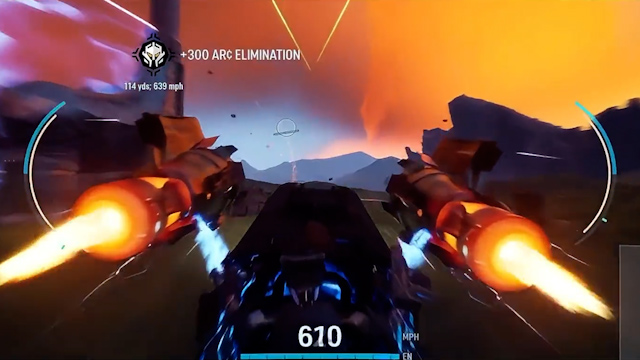
Ascent: Rivals has opened beta sign-ups for its combat racing battle royale, letting players request access to a playtest that blends high-speed ship combat with last-man-standing elimination.
The game puts you in a scrap-built ship with dual-engine twin-stick controls — independent thrust, lift, and strafe axes that promise nuanced handling at speed. Charging your one-hit-kill cannon temporarily surrenders piloting control, creating a risk-reward layer on top of the racing line. Seven tuning categories let you balance top speed, handling, and warp style to match your approach.
Combat Racing's Quiet Revival
Combat racing has been dormant for years. Wipeout and F-Zero defined the genre's peak, but modern attempts — GRIP, Distance, Trailblazers — struggled to find an audience. Ascent: Rivals bets on battle royale structure to solve the player-count problem: 20-40 ships per match means full lobbies even with a modest concurrent base, and elimination pacing gives spectators something to watch between deaths.
The twin-stick control scheme is the real differentiator. Most arcade racers map steering to one stick and throttle to a trigger. Splitting thrust, lift, and strafe across both sticks suggests a skill ceiling closer to a mech sim than a kart racer. If the physics hold up, the gap between a competent pilot and a great one could be massive — exactly what a competitive multiplayer game needs.
The Energy Gamble
Charging a one-hit-kill weapon while losing piloting control is a bold design choice. It turns combat into a commitment: you're a sitting duck while charging, vulnerable to anyone who predicted your line. That creates natural mind games — feint a charge to bait a dodge, or commit early on a straightaway where you can't be intercepted. The tactic only works if the maps give you enough straight sections to charge safely but enough cover to make positioning matter.
Seven tuning categories is a lot of knobs to turn for a beta. Top speed, handling, and warp style are the three called out; the other four aren't detailed yet. If the tuning depth is real, the meta will shift fast once players optimize builds for specific maps. If it's illusion of choice — three viable builds, four trap options — the system becomes busywork.
Why Now
The battle royale boom has cooled, but the genre's infrastructure — matchmaking, spectator tools, seasonal content pipelines — is mature. A new entrant doesn't need to build that from scratch. Ascent: Rivals also arrives as live-service fatigue pushes players toward games with shorter session times. A racing battle royale match likely runs 8-12 minutes, closer to a Rocket League game than a Warzone drop.
There's also the Steam Deck factor. Twin-stick controls map naturally to a handheld's trackpads and sticks. If the game runs well on Deck — and the visual style suggests it should — Valve's hardware becomes a ready-made audience for a control scheme that suffers on keyboard.
Skepticism Warranted
Combat racing lives or dies by netcode. High-speed collisions with physics-driven ships are a synchronization nightmare. One desync turns a clean pass into a teleporting wreck. The beta will reveal whether the networking holds up at 40 players, but history suggests caution: even established studios struggle with this.
Monetization is the other unknown. The sign-up page doesn't mention pricing model. Free-to-play with cosmetic seasons is the safe bet for a battle royale, but a premium price with earned unlocks would signal confidence in retention. Either way, the progression system needs to respect the skill expression the controls promise — no pay-to-win tuning slots.
What to Watch
The playtest dates haven't been announced beyond "request access." When they land, watch for: how the warp mechanic interacts with map verticality, whether the cannon charge time creates a skill gap or a frustration spike, and if the tuning system produces distinct archetypes or a single dominant build. The genre needs a hit. Ascent: Rivals has the mechanical ambition to be one — now it needs the execution.




Comments (0)
Loading comments…