
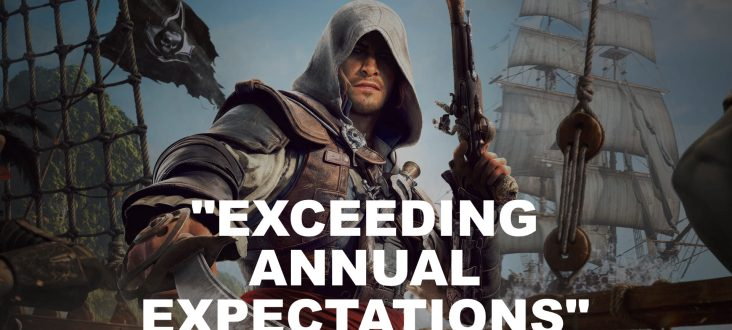
Assassin’s Creed Black Flag Resynced has sold 3.5 million copies in its first 14 days, Ubisoft said, putting the remake ahead of its annual expectations before the launch window has even settled.
The publisher used “sold-in” language in its latest earnings update, which usually means units shipped or booked into the sales chain rather than a perfectly clean read on finished player purchases. That distinction matters, but it does not change the headline: Ubisoft was expecting a slower climb, and Black Flag Resynced is climbing faster.
The 3.5 million figure is only part of the story
Ubisoft had already said the game had crossed 3 million copies, so the jump to 3.5 million is the part that makes the report feel unusually strong. The raw number is impressive for a remake, but the timing is what turns it into a strategic win.
Black Flag was one of Assassin’s Creed’s strongest modern entries, and its pirate fantasy still has an obvious hook: naval combat, Caribbean exploration, open-world freedom, and a looser tone than the franchise’s more recent military-heavy games. Resynced can sell nostalgia without asking new players to decode a decade of continuity.
“Released on July 9, 2026, Assassin's Creed Black Flag Resynced has made a strong start with 3.5 million copies sold-in to date, exceeding annual expectations within its first 14 days.”
That quote is doing a lot of work. Ubisoft is not just celebrating a good launch; it is telling investors that a legacy Assassin’s Creed property can still generate franchise-scale momentum when it is refreshed properly.
Why Black Flag is a safer bet than a brand-new Assassin’s Creed
Remakes are attractive because they reduce some of the risk that comes with launching a new open-world game. A publisher still has to spend money on development, marketing, and platform support, but it already has a recognizable world, a known player base, and a built-in argument for why the game deserves another look.
That matters more now than it did a few years ago, when every major studio seemed willing to chase a live-service dream regardless of cost. The market has become less forgiving, and Ubisoft has reason to favor projects that can turn existing goodwill into revenue without requiring a total reinvention of the franchise.
What this changes for Ubisoft’s next moves
The most obvious lesson is that Ubisoft will probably double down on remakes. The less obvious lesson is that the company may have been underestimating how hungry players are for polished reissues of beloved older games, especially when those games still have a clear identity.
The rumoured Assassin’s Creed 1 remake is the next thing to watch. Black Flag Resynced’s early numbers make that project feel less like a fan wish list item and more like a decision Ubisoft may eventually have to justify.
Why players should care, even if they do not own it yet
For players, this is not just corporate number-crunching. A strong remake launch can mean more classic games getting modernized, more pressure on publishers to make those projects feel worth the ask, and more competition for the attention of players who only have so many weekends to spend.
Ubisoft has not released the same-store comparisons against Assassin’s Creed Shadows, Valhalla, or Mirage in the same update, so the exact competitive ranking is still unresolved. What is clear is that Resynced is starting from a position of strength, and the 10 million-copy question is now a reasonable conversation rather than pure speculation.
The remake boom has limits
There is still a catch. A remake can inherit a franchise’s strengths while also inheriting its baggage, and players are less patient than publishers may hope when a “remake” feels like a cosmetic refresh. Black Flag has enough goodwill to survive some repetition, but that goodwill is not infinite.
Ubisoft’s challenge is to prove this is a playbook, not a one-off. If Black Flag Resynced keeps moving, the company will have a stronger case for putting more of its catalog through the same process. If sales slow, the lesson will be much narrower: Black Flag is a special asset, not proof that every old Assassin’s Creed deserves a redo.
For now, 3.5 million copies in 14 days is the story. It says less about a single launch and more about Ubisoft discovering that its past can still move boxes faster than expected.

Comments (0)
Loading comments…