
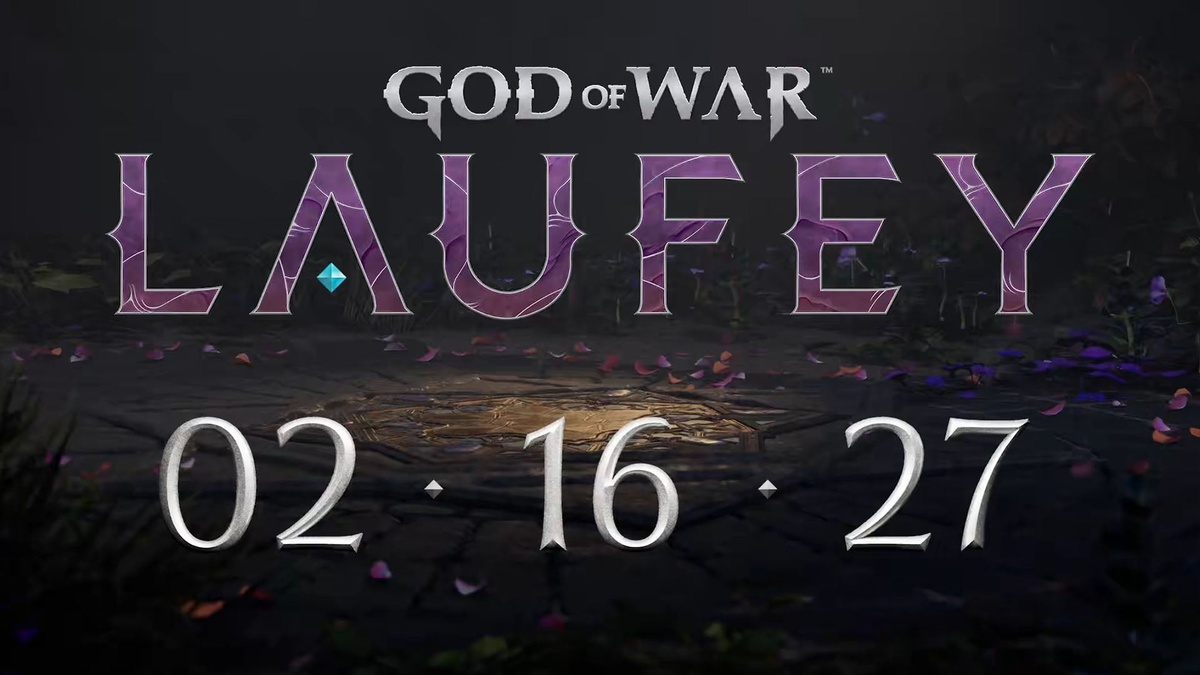
Sony and Santa Monica Studio have confirmed God of War Laufey for PlayStation 5 with a February 16, 2027 release date, putting players in control of Faye — Kratos' wife and Atreus' mother — in a standalone adventure set in the Norse afterlife known as the Everywhen.
The announcement arrived via a release date trailer that shows Faye awakening in a strange realm after her death, discovering that the safeguards she arranged to protect her family have been compromised. The Everywhen is described as a convergence point where "ruthless gods from across mythology vie for power in a land overflowing with dangerous magic." Gameplay glimpses suggest a faster, more precision-oriented combat style built around Faye's speed and relentlessness rather than Kratos' brute force.
This wasn't a surprise to anyone who finished God of War Ragnarök. The post-credits scenes made it clear Santa Monica had more to say about Faye's past and her influence on the saga's events. What is notable is the timing — nearly five years after Ragnarök's 2022 launch, and the first mainline entry without Kratos as the playable protagonist since the franchise began in 2005. Sony's first-party slate has been unusually quiet for 2025-2026, and Laufey effectively anchors the PS5's late lifecycle with a tentpole exclusive.

The shift to Faye changes the mechanical vocabulary in ways that matter. Ragnarök already experimented with Atreus sections that emphasized ranged combat and traversal over raw strength. A full game built around Faye's "decisive, deadly precision" suggests Santa Monica is finally committing to a distinct combat identity — one that could lean harder into parry windows, dodge-cancel mechanics, and aerial control. If the studio treats this as more than a reskin, Laufey could be the most technically demanding entry yet.
The Prequel Problem
Here's the friction point: we know how Faye's story ends. She dies before the 2018 game begins. Her fate is fixed. The tension in a prequel isn't whether she survives — it's whether the journey adds meaningful texture to a character who has functioned largely as a mythic presence rather than a person. Ragnarök dipped into her backstory through memories and recordings; a full campaign needs to justify its existence beyond filling lore gaps. The Everywhen setting helps — it's a metaphysical space where consequences can be weird and mythological — but the narrative ceiling is visible from the start.
There's also the question of what "God of War" means without its namesake. Kratos' arc — from vengeance to fatherhood to something resembling peace — has been the franchise's throughline for eighteen years. Removing him isn't just a casting change; it's a structural gamble. Santa Monica has earned trust, but they've also never built a God of War game around a protagonist who isn't defined by rage.
What This Signals for Sony's Strategy
Laufey arrives in a window where Sony's first-party output has skewed heavily toward live-service bets (Helldivers 2, Concord, Fairgame$) and PC ports. A narrative-driven, single-player exclusive with a fixed release date is a deliberate statement: the blockbuster story game isn't dead, and it's not becoming a GaaS hybrid. The February 2027 slot also positions it as a bridge to whatever comes next — likely a PS6 launch title or a soft reboot set in a new mythology.
For players, the immediate takeaway is simple: the next God of War is dated, it's single-player, and it's not a spin-off. Whether Faye's combat loop carries a 15-hour campaign without Kratos' gravity is the real question — and we won't have a real answer until Santa Monica shows extended gameplay. Expect that sometime in 2026, likely around Summer Game Fest or a dedicated State of Play. Until then, the Everywhen waits.
Comments (0)
Loading comments…