
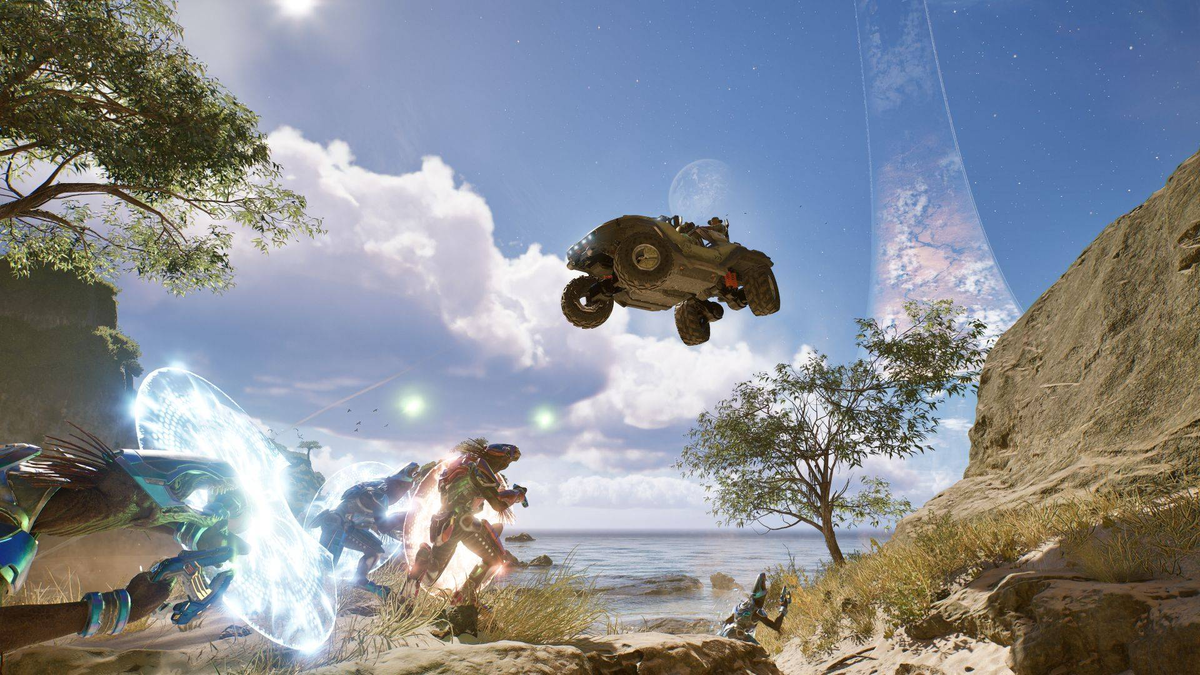
Halo: Campaign Evolved is frustrating early-access players because trying to leave mission boundaries on classic Halo: Combat Evolved maps can kill Master Chief instead of letting him explore the edge of the level.
The issue is not a new gameplay mode or a controversial difficulty change. It is a boundary death system that appears to punish players for doing something longtime Halo fans have been trying to do since 2001.
The remake is catching a very specific Halo habit
Halo: Campaign Evolved is out now in early access on PlayStation 5, Windows PC, and Xbox Series X, with Halo Studios rebuilding Halo: Combat Evolved from the ground up on Unreal Engine 5.
The remake has been praised for preserving the shape of Bungie's 2001 shooter, including its strange physics and the feeling that every visible mountain, ruin, and rooftop might hide a shortcut.
That last part is exactly what is now causing trouble.
In a clip shared on Reddit, Reddit user KyxeMusic jumps along narrow ledges on the Silent Cartographer and climbs a derelict Forerunner structure before Master Chief suddenly dies.
Then the same stunt works twice, which is what makes the clip so annoying to watch: this is not a player getting flung into the void by a broken physics trick, but a deliberate attempt to test the edge of the level.
The Halo subreddit became the place where that frustration landed quickly:
In the post, KyxeMusic asked, "What's the point of having skulls in a game if you're going to kill me for exploring?" The top response was blunt: "Fucking bullshit." Another player wrote, "Halo should only have death boundaries on massive falls."

That reaction may sound dramatic, but boundary testing has been part of Halo's DNA since the beginning. The original games trained players to look past the road, climb toward the obvious destination, and see whether the world would let them get there.
Boundary testing has been part of Halo since the first game
In the original games, Bungie often modeled geography beyond the intended path instead of relying entirely on invisible walls or distant skyboxes.
That made the edges of levels visible, readable, and tempting. The first-person view made it easy to imagine that the mountain in front of you was not just scenery, but a place you could climb.
The Elder Scrolls 5: Skyrim "If you see that mountain, you can go to it" idea is familiar now, but Halo was already asking players to take the scenic route.
The original Silent Cartographer made this especially obvious. Set on a circular island, the mission gave players a Warthog, a central mountain, and enough explosive options to turn the whole map into a physics experiment.
Team up with a friend and launch the Warthog up the mountain, and you could skip sections of the level in ways the designers clearly did not intend.
Halo 2 carried the tradition into Metropolis, where players could climb buildings and find a giant soccer ball on a roof.
It did not change the mission or unlock a major secret, but it became a tiny, weird reward for looking where the game told you to walk.
There is an old, unconfirmed story that Bungie left the ball in as a physics test and forgot to remove it.
That story may be false, but it captures the feeling fans have of Halo as a game full of accidents that became part of the culture.
Later entries used harder limits, and some fans remember those games more for locked-off spaces than for unsanctioned exploration.
But for a lot of longtime Halo players, the best memories still come from staying up too late with friends, getting lost in the mountains of Delta Halo, or finding a collectible tucked behind a wall that was not meant to be behind.
Why this remake is exposing the problem
The boundary deaths in Halo: Campaign Evolved are especially noticeable because the remake is built to recreate the original experience, not just borrow its story and characters.
Halo Studios replicated the bones of Halo: Combat Evolved, including the "uniquely nonsensical rules of physics" that made the original feel so different from other shooters.
That creates a tricky design problem. If the remake removes too many old freedoms, it risks feeling like a museum piece.
If it preserves too much, it can also break pacing, expose unfinished geometry, or let players reach places where the level's enemy placement, lighting, or collectibles no longer make sense.
The current frustration suggests Halo Studios has preserved enough of the old level logic to invite exploration, but not enough freedom to let that exploration continue.
Remakes are now a major part of the industry, and nostalgia is not just a mood. For publishers, an old game can be a safe way to test whether a franchise still has appetite without the risk of a brand-new concept.
For players, it is a chance to revisit the version of a game they remember, including the bugs, shortcuts, and weird little discoveries that no manual ever explained.
The challenge is capturing that nostalgia 25 years after the fact without letting the remake feel either too open to break or too sealed off to feel alive.
Comments (0)
Loading comments…