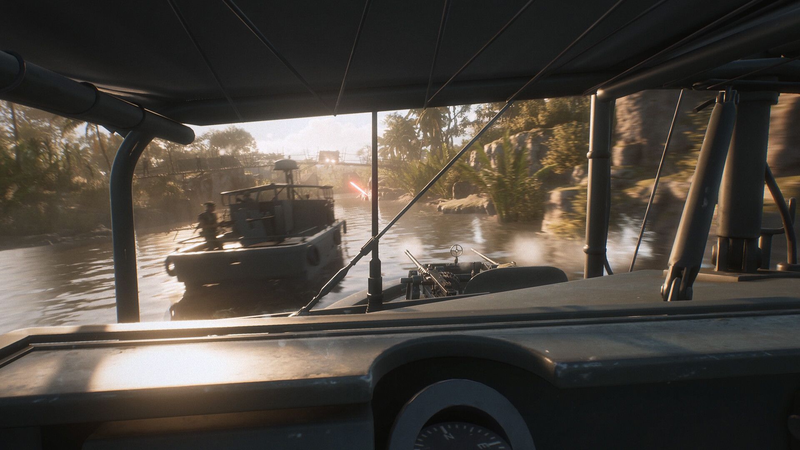
H ell Let Loose is getting ready to take on an entirely new setting – the Vietnam war. With this, however, comes a host of challenges, ranging from new environments to more modern weaponry, and even different styles of combat. Game director Paul Ruschynsky, technical director Kieran D’Archambaud, audio director Richard Blackley, and lead level designer Chris Robinson were kind enough to talk to us about how this shift to a new setting will affect Hell Let Loose going forward. How do you expect the move from World War 2 to the Vietnam War to affect gameplay beyond the obvious change in weapons? Ruschynsky: The asymmetrical sides truly shake up the gameplay from World War 2, resulting in contrasting gameplay depending on the side you choose. That, combined with the faster pacing of combat and new ways to manoeuvre around each map, makes it feel like a familiar game at its core but fresh in the moment-to-moment action. Additionally, the battlefields are distinctly different to fight within. They’re built around wet dense jungle, winding river networks, farmland and rice paddies, remote villages, and steep natural terrain. Vegetation specifically massively impacts visibility and movement, making it a defining feature of the battlefield that changes how you interact with it. "The map variety in Hell Let Loose: Vietnam is diverse." What kind of map variety can players expect from Hell Let Loose: Vietnam , especially given how important terrain, visibility, and verticality are to the setting? Robinson: The map variety in Hell Let Loose: Vietnam is diverse. It was important for each map to have its own identity; its own unique look and feel, not just in the chosen jungle, grassland, and desert biomes, but also in the gameplay opportunities each map offers and the tactics players can employ to take advantage of those opportunities, such as mountainous terrain, caves, and flooded villages. Each map needed to deliver a different battlefield experience, with players facing new challenges, tactical opportunities, and intense & immersive moments. Will players be able to contribute to battles in ways beyond direct combat, such as traps, fortifications, supply roles, or other support mechanics? Ruschynsky: Direct combat has never really been the focus of Hell Let Loose , and we lean into this further by adding more deployables to the battlefield, such as Anti-Air Guns, by bringing in more roles that focus on support, like the Helicopter unit and providing more tools to engage with tactical manoeuvring, namely the NVA tunnels. To succeed in Hell Let Loose: Vietnam , a good kill/death ratio will help, but ultimately it’s about the team effort and working towards shared tactics, relying more on effective communication than anyone’s shooting skills. Are stealth mechanics being expanded in Hell Let Loose: Vietnam , or is stealth still primarily driven by player awareness, positioning, and communication? Ruschynsky: The dense jungles naturally offer players more opportunities to act stealthily, and it was important from a gameplay perspective that this natural cover doesn’t slow down the pacing or encourage stealth too much. So through both audio and visual cues, we make sure that players are both heard and seen whenever they’re moving through the jungle to give players a fair chance of reacting to them. Blackley: During early playtests, we identified a need for players to be able to hear if an enemy is sneaking through the undergrowth around them. What audio cues to give the player is important in a game like Hell Let Loose: Vietnam , especially when a lot can be happening around you. Player movement sounds scale dependent on a player’s speed and also whether you are a friendly or an enemy in the vicinity of the player. "We knew early on that the tutorials would need to be a single-player experience" What have been the biggest challenges in designing onboarding and tutorials for a game built around large-scale, tactical warfare? Robinson: We knew early on that the tutorials would need to be a single-player experience, so it was important not only to teach the player the game’s fundamentals in a clear, understandable, and engaging way, but also, where appropriate, to teach the strategic intent behind certain actions. The challenge here was finding the balance between teaching the player what they needed to know and giving them the bigger picture and the influence each role and vehicle has on the battlefield. Will Hell Let Loose: Vietnam feature any form of meta progression, or are you keeping progression focused around roles, teamwork, and match-to-match mastery? Ruschynsky: The focus is still very much around roles, teamwork, and match-to-match mastery, however we expanded upon the role progression with the addition of a weight-based loadout system. By levelling up each role, you’ll unlock more slots and be able to carry more weaponry and equipment into the battlefield, giving you more flexibility to tailor each one to your playstyle. Are there plans to expand the weapon, map, role, or game mode offerings through post-launch updates? Ruschynsky: We’re excited to continue supporting Hell Let Loose: Vietnam after launch, working directly with the community to expand and evolve the game over time. Right now, we’re very much focused on ensuring we have a smooth release for players across all platforms. How difficult has it been to balance the game around asymmetrical warfare? For example, what tools will Vietnamese forces have against US aerial firepower? Ruschynsky: Balancing is the single biggest challenge we have. We’ve really leaned into the asymmetrical gameplay between the United States and the North Vietnamese Army (NVA), which means that we’ve had to make sure that both sides have ways to counter the enemy’s strategy. For example, the US might have helicopters to take to the skies, but the NVA can deploy Anti-Air guns to control the airspace. And the NVA’s tunnels can be collapsed by the US, bringing down entire underground networks and killing anyone that might have been in them at the time. "PC also offers full freedom over your resolution, including Ultrawide (21:9) and Super Ultrawide (32:9) support." Since Hell Let Loose: Vietnam is coming to PS5, Xbox Series X/S, and PC, what resolution and frame rate targets are you aiming for on each platform? D’Archambaud: All consoles are specifically targeting a 60 frames per second experience, whilst on PC, you can push it as high as your hardware will allow! PC also offers full freedom over your resolution, including Ultrawide (21:9) and Super Ultrawide (32:9) support. Whilst the consoles each have different internal resolutions and different resolution output targets (scaled with TSR), along with DRS for a smoother experience. Ruschynsky: We’ve added lots of new Image Reconstruction video settings to allow you to scale the experience relative to your PC hardware, with DLSS 4.5 with Frame Gen for those with Nvidia GPUs. And those with AMD GPUs will have access to TSR for both scaling and anti-aliasing. On top of that, PC users have the ability to enable Hardware Lumen, which uses various raytracing effects to improve the lighting and shadowing. From a developer perspective, what are your thoughts on PS5 Pro, and how does its added GPU power change what you can deliver compared to the base PS5? D’Archambaud: Any time we have more powerful hardware, we are keen to utilise it to the best we can. We offer a number of high-end graphical features on PC, and leading up to launch, we are working to enable and optimise as many as possible on each console. Are you planning to use PSSR on PS5 Pro, and what kind of visual or performance improvements could it allow for a large-scale shooter like Hell Let Loose: Vietnam ? D’Archambaud: We do plan to integrate PSSR, however, this may be an improvement that is added as a free update in the months after initial launch. On PC, what kind of scalability are you targeting across lower-end and high-end hardware, especially with large maps, vehicles, foliage, and dense combat scenarios? D’Archambaud: As well as all the normal quality settings you would expect on a modern PC game, we offer image reconstruction options such as DLSS and TSR. If choosing TSR, you can define the resolution scale to use. You can choose to use frame generation and hardware Lumen, too. As well as all these options, optimisation work is ongoing across all areas of the game as we approach launch. "From an audio perspective, we are using an entirely new voice chat system" How are you approaching crossplay, server browser support, and platform parity between PC and consoles? D’Archambaud: We have reworked all network aspects to ensure 100% platform parity across all game features. We realised partway through development that the work done means that we can offer full crossplay too. Of course, not all players want this, so we have been careful to allow full configuration on both the server (for community server owners) as well as on the game client, too, so both players and server owners can configure the experience that they desire. Given how important communication is to Hell Let Loose , what improvements are you making to voice chat, squad coordination, and command tools in Vietnam? Blackley: From an audio perspective, we are using an entirely new voice chat system, which in turn is being piped into our audio middleware, FMOD, which is also new for Hell Let Loose: Vietnam . This enables the audio design team to adjust how voice chat is experienced by players, so things like effects and custom distances can be set on specifics such as the proxy chat – a huge part of Hell Let Loose . We are also anticipating players needing this even more with the addition of boats and helicopters to the game. We have already witnessed increased team coordination and fun interactions from the increased distance players can be heard from, which has been great to see and hear! This is an area we plan to develop further from player feedback, post-launch, so watch this space for more. Ruschynsky: Voice chat via the radio across the three hierarchical channels is central to communications, but players will also be able to text chat, use pings in the action and place down markers on the tactical map. The latter have been updated with more contextual information that will aid you in quickly informing your teammates of threats or actions you need them to perform.
As an Amazon Associate we earn from qualifying purchases. Some links on this page are affiliate
links — if you click through and make a purchase, we may earn a commission at no extra cost to
you.




Comments (0)
Loading comments…