
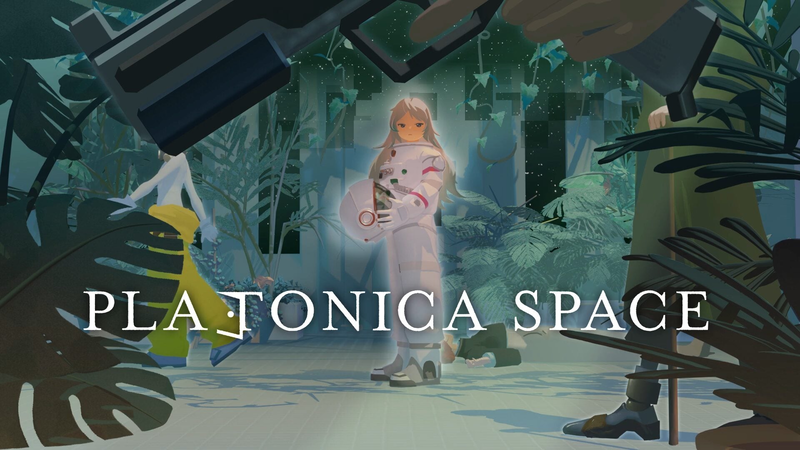
PLATONICA SPACE, a psychological space exploration adventure from developer Kazuhide Oka and publisher KAMITSUBAKI STUDIO, launches on Steam August 14. The game traps players in an endless maze of interconnected rooms built from fragmented memories, where placing items in specific locations triggers recollections that may or may not belong to you.
A Shifting Labyrinth of Memory
The core loop revolves around exploration and deduction. You wake in an unfamiliar room, step through a door into another, and another — each space a fragment of someone's past. Items found throughout the environment serve as memory keys: a knife placed in a kitchen might recall cooking, but that same knife in a bedroom could unlock something far darker. The twist is that not every memory you recover is yours. Other girls wander the same corridors, equally amnesiac, and their fragmented pasts bleed into yours. Sorting truth from borrowed experience becomes the path forward.

The Sleepiness Mechanic Changes Everything
Every action increments a Sleepiness gauge. Fill it, and you collapse — waking to a completely reshuffled layout. Room connections shift. Item placements change. Your inventory vanishes. This roguelite structure means no two runs play identically, forcing players to plan routes with surgical precision. Do you push deeper for a crucial memory fragment, or conserve energy to place the items you already hold? The tension between curiosity and survival creates a natural pacing that pure exploration games often lack.
Trust No One, Question Everything
The other trapped girls offer hints and companionship, but the game explicitly warns: everyone has secrets. This social deduction layer elevates PLATONICA SPACE beyond environmental storytelling. You're not just reconstructing a past — you're navigating present-day deception from characters who may not even know they're lying. Their forgotten histories intertwine with yours in ways that only become clear through repeated runs and careful cross-referencing of recovered memories.
KAMITSUBAKI STUDIO's Growing Indie Footprint
Publisher KAMITSUBAKI STUDIO has quietly built a reputation for distinctive narrative experiments, often blending music, visual art, and unconventional game structures. Their involvement suggests PLATONICA SPACE isn't just a solo passion project — it's a curated release with production values that belie its indie scale. The music credit to agehasprings Party (known for Vocaloid and anime-adjacent work) and character design by Moe Katakura point to a cohesive audiovisual identity that could help the game stand out in Steam's crowded August calendar.
A Crowded Genre, But a Distinct Voice
Memory-exploration games have proliferated since What Remains of Edith Finch and Outer Wilds proved players crave non-linear narrative archaeology. Recent entries like The Plane Effect and MIND: Path to Thalamus mine similar territory. PLATONICA SPACE differentiates through its procedural room shuffling and the explicit unreliability of its cast. The "whose memory is this anyway" mechanic adds a social dimension that pure environmental games lack — you're not just reading diaries; you're interrogating unreliable narrators in real time.
Potential Friction Points
The sleepiness gauge could frustrate players who prefer uninterrupted exploration. Forcing a reset every 15-20 minutes (depending on tuning) risks breaking narrative momentum at critical moments. Roguelite structure also means key story beats might gate behind unfavorable room generations — a common genre complaint. And with a solo developer handling scenario and programming, scope creep or technical roughness at launch wouldn't be surprising. The English translation by Marco Godano will need to carry nuanced psychological dialogue; a clunky localization could undermine the entire premise.
What to Watch For
The August 14 launch positions PLATONICA SPACE against heavier hitters like Black Myth: Wukong (August 20) and Star Wars Outlaws (August 30). Its success will depend on word-of-mouth from the narrative-adventure community and how well the procedural systems serve the story rather than dilute it. A demo or prologue chapter before launch would help — the concept is easier to grasp in motion than in description. If the memory-placement puzzles land and the character writing sustains multiple runs, this could become a quiet standout in a month dominated by blockbusters.



Comments (0)
Loading comments…