
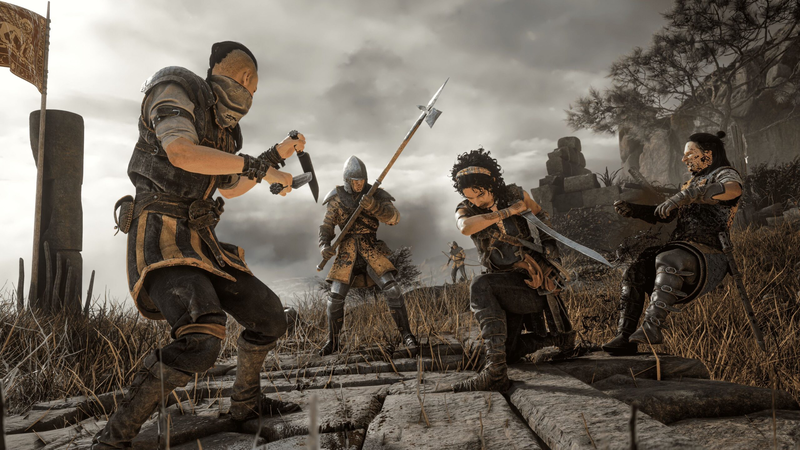
Resonance: A Plague Tale Legacy launches August 27 on Xbox Series X/S, PlayStation 5, and PC, and its newest trailer makes one thing clear: light isn't just atmosphere this time — it's the core mechanic. The prequel follows Sophia, a new protagonist navigating the Minotaur's Islands centuries before Amicia and Hugo's journey, wielding a mysterious sphere that manipulates illumination to solve ancient temple puzzles and survive whatever stalks the darkness.
The Announcement

Focus Entertainment and Asobo Studio dropped the latest look at Resonance this week, centering entirely on the interplay between light and shadow. The trailer shows Sophia using her glowing orb to activate dormant mechanisms, reveal hidden pathways, and repel unseen threats in crumbling ruins. It's a deliberate shift from the rat-swarm survival horror that defined A Plague Tale: Innocence and Requiem. Where those games used light as a temporary sanctuary — a brazier to hold back the tide — Resonance builds entire puzzles around directing, reflecting, and timing beams of light through complex environmental setups.
The Minotaur's Islands setting suggests a Mediterranean locale, possibly Greek given the Theseus references. Sophia appears to be experiencing fragmented memories of the mythological hero, hinting at a deeper connection between the Macula — the supernatural bloodline curse at the series' heart — and ancient history. The sphere she carries doesn't look like alchemical craftsmanship; it pulses with something older, almost technological.
Why This Now

Asobo has spent six years refining the Plague Tale formula. Innocence (2019) was a linear, narrative-driven stealth game. Requiem (2022) expanded the scope with larger areas, more combat options, and a heavier emphasis on player choice. Resonance represents the studio's first major structural experiment: a prequel starring a new protagonist, built around a single mechanic rather than the franchise's signature horde simulation.
The timing aligns with a broader industry shift. Single-player action-adventure games are increasingly built around "one big idea" — Alan Wake 2's dual-reality switching, Immortality's match-cut editing, Cocoon's orbital puzzle logic. Asobo isn't chasing trends so much as proving the Plague Tale framework can support more than rat avoidance. If the light mechanics hold up across a full campaign, the studio earns a reusable toolkit for future projects.
Deconstruct the Impact
For players, the immediate question is pacing. Plague Tale games thrive on tension-and-release cycles: quiet exploration punctuated by desperate sprints through swarming rodents. Light-puzzle games operate on a different rhythm — methodical observation, trial and error, the satisfaction of a click. Merging them risks diluting both. If the sphere trivializes encounters by freezing enemies in place, the horror evaporates. If puzzles demand precision while threats close in, frustration replaces fear.
The prequel structure carries its own risks. Sophia's story must justify its existence without Amicia or Hugo. The Macula lore — previously grounded in medieval superstition and alchemy — now stretches back to classical antiquity. That's a rich vein, but it demands careful handling. Requiem already pushed the supernatural elements into explicit fantasy territory; Resonance doubles down. Longtime fans who valued the series' historical fiction veneer may find the mythological pivot jarring.
On the competitive side, Resonance launches into a crowded August. Black Myth: Wukong arrives August 20. Star Wars Outlaws follows August 30. Visions of Mana drops August 29. A narrative-driven, puzzle-heavy prequel from a respected studio could carve out a dedicated audience — especially on Game Pass, where Focus titles often appear day one — but it won't command the cultural oxygen of those heavier hitters.
The Broader Trend
Light-as-mechanic has deep roots. Ico (2001) used reflected beams to open doors. The Witness (2016) built an entire island around perspective and illumination. Control (2019) turned fluorescent tubes into combat tools. What's new is the genre blending: horror-adventure-puzzle hybrids where light serves survival, progression, and narrative revelation simultaneously.
Asobo's approach resembles Alan Wake 2's flashlight mechanic elevated to a traversal and puzzle system. Both games treat light as information — revealing what darkness conceals, whether that's a path forward or a memory fragment. The difference is tone. Alan Wake 2 is metaphysical thriller; Resonance appears to be archaeological horror. The Minotaur's Islands suggest labyrinthine structures, which fits both the Theseus parallel and a puzzle-game architecture.
Counterpoint
There's a version of Resonance that feels like a tech demo stretched to full price. The sphere mechanic could become repetitive if the puzzle vocabulary doesn't evolve — redirect beam, activate switch, repeat. The trailer shows impressive variety (mirrors, prisms, timed shutters, water reflections), but trailers cherry-pick. A ten-hour game needs fifty distinct ideas, not five recycled twenty times.
The prequel problem looms larger. We know Sophia eventually meets Amicia and Hugo. That meeting is the narrative anchor. Everything before it is backstory — and backstory is inherently lower stakes. Resonance must make Sophia's journey feel essential, not explanatory. If her arc exists only to drop lore breadcrumbs for the main timeline, the game fails as a standalone experience.
Performance is another unknown. Requiem struggled on consoles at launch, with frame drops in rat-heavy sequences. Resonance trades swarm simulation for complex lighting calculations — dynamic global illumination, real-time reflections, volumetric fog. That's a different GPU burden. Asobo's engine has improved, but the studio has never shipped a game built entirely around real-time light propagation.
What Comes Next
August 27 will answer the mechanical questions. Review embargoes typically lift 24-48 hours before launch for Focus titles. Watch for coverage of puzzle progression: does the sphere gain new abilities (color filtering, intensity control, splitting beams)? Does the game introduce non-light mechanics — stealth, traversal, combat — to vary the pace?
The lore implications matter more long-term. If Resonance establishes the Macula's origin in antiquity, it opens the door for future entries in any historical period. A Plague Tale set during the Bronze Age collapse. The Antonine Plague. The Black Death was just one outbreak; the bloodline spans millennia. Asobo now has a franchise framework that isn't tethered to 14th-century France.
For now, the trailer delivers on its promise: gorgeous environments, a clear mechanical identity, and enough mystery to sustain interest. Whether that translates to a essential entry or a curious footnote depends on execution. The light looks good. We'll see what it reveals.



Comments (0)
Loading comments…