
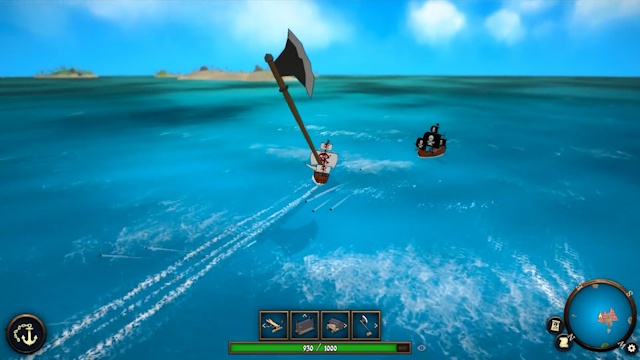
Roguebound Pirates launched its open beta this week, letting players test an action roguelike where your grid-based inventory is your ship — every piece of gear you slot physically manifests as part of your vessel's layout, turning inventory management into ship design.
The Hook: Inventory as Architecture
Most roguelikes treat inventory as a static menu. Roguebound Pirates makes it the game. Weapons, shields, engines, and utility modules occupy a grid; their placement determines firing arcs, shield coverage, engine thrust vectors, and adjacency bonuses. A cannon next to a capacitor fires faster. A shield generator beside a reactor regenerates quicker. The ship you fly is literally built from the loot you're carrying.
Missions vary objectives, starting loadouts, and rulesets per run. Completing them earns resources for a persistent pirate base that unlocks new equipment, gameplay features, and cosmetic emblems. Multiple difficulties, specialties, and a "massive arsenal" round out the package.
Why This Mechanic Works Now
The roguelike market is saturated. Developers are hunting for hooks that survive first contact with Steam's algorithm. Deckbuilders did it with card synergy. Auto-battlers did it with positioning. Roguebound Pirates bets on spatial reasoning — the same satisfaction of fitting Tetris pieces, applied to buildcraft. It turns a chore (inventory tetris) into the core strategic loop.
That loop also solves a persistent roguelike problem: late-game clutter. When every item physically occupies your ship, you feel the weight of each pickup. Discarding a module means a literal hole in your hull.
Where It Fits in the Genre
We've seen adjacent ideas. FTL let you manage ship systems but not build the hull. Starbound and Terraria let you build ships but not as a roguelike run mechanic. Cobalt Core merged deckbuilding with positional combat. Roguebound Pirates sits in a rare intersection: real-time action, spatial buildcraft, and run-based progression.
Reasons for Caution
Grid inventory systems can become tedious fast. If the UI fights the player — rotating pieces, snapping issues, unclear adjacency rules — the novelty curdles into friction. Balance is another question: powerful adjacency combos risk creating dominant builds that trivialize higher difficulties, while weak ones make the mechanic feel irrelevant. The beta exists to stress-test exactly this.
There's also the meta-progression trap. Base-building unlocks that gate equipment behind grind can undermine the "fresh run" promise if players feel compelled to farm before the real game starts.
What to Watch
The beta is accessible via a "Request Access" button on the game's Steam page. No public date for full release yet. Key signals in the coming weeks: how quickly the dev team iterates on UI clarity, whether adjacency bonuses create meaningful build diversity or a single optimal layout, and whether the base progression respects player time. If the grid feels like a puzzle you want to solve rather than a spreadsheet you manage, Roguebound Pirates could carve out a durable niche.
Comments (0)
Loading comments…