
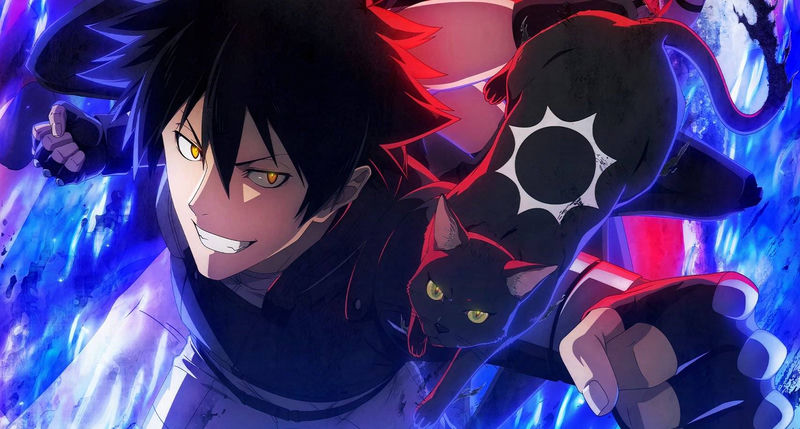
Black Torch is not “Chainsaw Man for cat people” in the lazy sense; it is one of the series that helped build the monster-fusion shonen template later popularized by Chainsaw Man, Jujutsu Kaisen, and Kaiju No. 8, with Rago the foul-mouthed cat spirit giving it a sharper, weirder identity.
That distinction matters because the similarities are obvious. Jiro Azuma, a teenage punk, dies at the hands of a demon, then fuses with Rago, an ancient mononoke, to become a uniquely powerful hybrid. From there, demons hunt him, a secret government agency wants him, and Jiro mostly reacts to the chaos instead of steering it.
The setup is undeniably close to Chainsaw Man. Denji gets Pochita, the Chainsaw Devil, in his chest; Jiro gets Rago, a black cat spirit, in his chest. Both stories turn a disposable underdog into the most dangerous person in the room almost immediately. Both also use that power-up as a trap: the monster inside saves the protagonist, but it also puts a target on his back.
The difference is Rago. Pochita becomes a soft, round dog form and largely serves as Denji’s emotional anchor. Rago is an ancient, overwhelmingly powerful spirit with the personality of a grumpy warlord trapped in a cute black cat’s body. He swears, grooms Jiro’s ears, insults him constantly, and refuses to behave like a mascot. “I’m no one’s property, wacko” is not just a catchphrase; it is the show’s thesis statement.
That dynamic makes Black Torch feel less like a derivative shonen and more like an ancestor with attitude. The manga began serialization in Jump Square in December 2016, before Chainsaw Man in 2018, Jujutsu Kaisen in 2018, and Kaiju No. 8 in 2020. In other words, this was not a late-stage trend chasing a trend. It was part of the machinery that helped define the current supernatural action boom.
The anime adaptation, which began airing on July 4 with new episodes arriving weekly on Crunchyroll, has so far covered roughly the first five chapters of the manga. The 12-episode season should be able to reach the original series’ 19 chapters, though the manga ended after only five volumes because sales and readership were lackluster.

That limited source material is the obvious risk. A lot of recent monster-fusion anime have benefited from long-running manga engines, which means more battles, more lore reveals, and more room for character arcs to stretch. Black Torch’s anime may end right as it is fully hitting its stride, which is annoying but not necessarily fatal. The source material is compact enough that the adaptation can still land with impact.
Still, the anime’s production context is promising. Tsuyoshi Takaki has been involved in supervising setting and storyboards, and has described the adaptation as “something even better” while respecting the original story. Close involvement from the creator is especially important when an adaptation is trying to preserve the weird tone of a property that was canceled too early. This is the kind of show where the balance between absurd comedy, body horror, and genuine menace can tip quickly.
Black Torch also has one of the more interesting power dynamics in the current shonen wave because Jiro is not merely a random punk who got blessed by a monster. Almost every character in the story comes from a long line of ninjas, and he can talk to animals. That ability gets him bullied as a kid, but it also gives him empathy and social awareness that many action protagonists lack.
This is where the show earns its heart. Jiro’s childhood dog, Nachi, functioned almost like a mother figure to him, and his ability to communicate with neighborhood cats made him an outsider among humans. The same trait that made him easy to mock also made him resilient. His altruism is not generic heroism; it comes from knowing what it feels like to be dismissed and misunderstood.
That makes the Rago partnership work better than it probably should. A talking cat companion can easily become a gag machine, but Black Torch keeps using the relationship to expose Jiro’s softer side. Rago is brutal, dismissive, and often cruel in the way powerful beings are cruel when they have no reason to pretend otherwise. Jiro, meanwhile, keeps answering that cruelty with patience and concern.
The anime’s early episodes lean into that contrast. The stakes are apocalyptic, but Jiro will still pause to talk to pigeons. He can face demons and secret agencies while casually bonding with animals around him. It is goofy, yes, but the goofiness is not separate from the story’s emotional logic.
For viewers coming in after Chainsaw Man, Jujutsu Kaisen, or Kaiju No. 8, Black Torch may feel familiar at first. The ingredients are recognizable: monster fusion, secret organizations, hidden histories, and protagonists whose bodies become the battlefield for larger conflicts. That familiarity can be comforting, but it can also make the show look less original than it is.
The key is that Black Torch is less interested in making its protagonist cool than in making him useful, compassionate, and strangely out of place. Jiro does not become powerful because he wants glory. He becomes powerful because a demon killed him and Rago decided to keep him alive. That lack of ambition is what makes the premise funny, frustrating, and oddly moving.
There is still a legitimate downside: the show’s premise can look derivative if judged only by the surface-level setup. A teenage boy fuses with a monster inside his body, gets recruited by an organization, and fights supernatural threats? That sounds like a remix of several bigger hits. The reason it works is in the texture: the ninja lineage, the animal communication, the deadpan humor, and Rago’s refusal to be cute on command.
Black Torch is especially worth watching if you like shonen anime with monster partners that actually dominate the chemistry. The best ones are not just sidekicks with power-ups. They are relationships with agenda, history, and personality. Rago is built less like a pet and more like an ancient problem wearing a tiny black-furred costume.
For fans waiting for more Kaiju No. 8, Jujutsu Kaisen, or Chainsaw Man, the anime is a useful stopgap with more personality than it first appears to have. New Black Torch episodes release weekly on Crunchyroll on Saturdays at 9 a.m. ET, and the early run suggests an adaptation that knows exactly what makes the manga distinctive.
The bigger takeaway is that Black Torch deserves more credit as a bridge between eras. It came before the current monster-fusion boom and quietly supplied several of its ingredients, but it never feels like a pale imitation of what came after. It is rougher, stranger, and more emotionally direct. In a genre crowded with devil contracts, cursed energy, and kaiju agencies, Rago the foul-mouthed cat spirit is exactly the kind of weird little demon that can make the template feel alive again.


Comments (0)
Loading comments…