

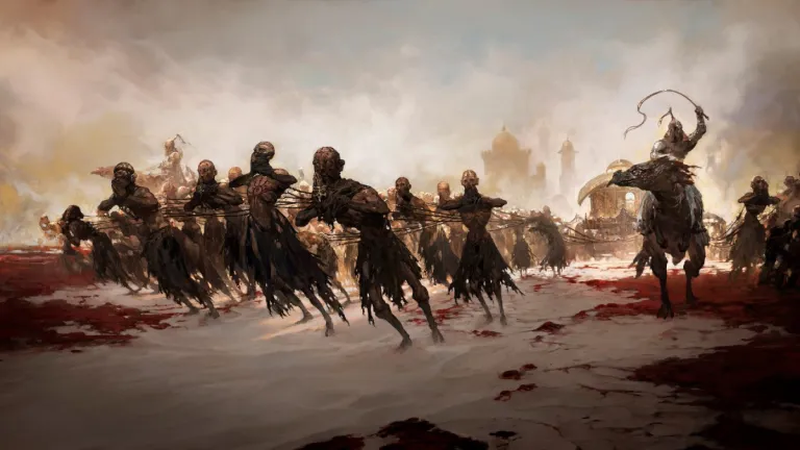
The skeleton army didn't march. It simply existed, thousands of them stacked in the same coordinate space, each one a tiny calculation the engine never agreed to handle. By the time Empyrian's party hit the Trials of the Sekhemas, the frame counter read twenty-eight — technically playable, if you consider a slideshow playable. The network graph looked like a heart monitor flatlining. This wasn't a boss fight. It was a stress test disguised as a victory lap.
Empyrian has made a habit of these end-of-league spectacles. The AI arms race between player creativity and engine limitations has been running since the original Path of Exile, but the sequel's early access period has given the community a fresh canvas. His "Minionmaxxing" project — the name is deliberately ridiculous, the execution anything but — targeted a simple question: how many minions can the game actually sustain before the simulation collapses? The answer, it turns out, is somewhere between "several thousand" and "the server disconnects you for your own good."
The build reads like a theorycrafting fever dream. Grip of Kulemak. Abyssal Signet. Ingenuity Utility Belt, max-rolled and corrupted. Kalandra's Touch. Beidat's Will converting every twenty-five life into maximum spirit. Each item represents months of farming or trading, the kind of currency investment measured in Mirrors of Kalandra — plural. They corrupted perfect rolls hoping for better perfect rolls. When the market didn't have what they needed, they crafted it. This is the economy of obsession, funded by the previous league's profits.
The Architecture of Absurdity

What makes this fascinating isn't the screenshot of a frozen client. It's the systematic dismantling of every assumed limit. Spirit reservation efficiency, usually a quality-of-life stat, becomes the primary damage scalar. Life stacking, traditionally a defensive layer, becomes offensive fuel through Beidat's Will. The party composition — multiple players running identical aura stacks — turns the game into a distributed rendering problem. Each skeleton is a draw call, a physics object, a network packet. Multiply by four players. Multiply by the auras buffing them. The engine doesn't care about your build guide. It cares about instruction throughput.
Grinding Gear Games has historically tolerated — even quietly encouraged — this kind of boundary-pushing. The original game's most memorable moments often came from players breaking systems in ways the developers hadn't anticipated: the AMD GPU that melted running a specific microtransaction effect, the instance crash caused by too many ground effects, the league mechanic that had to be emergency-patched because a player found an infinite loop. These aren't bugs. They're stress tests the QA team couldn't afford to run.
Why the Minion Cap Exists (And Why It Doesn't)

Technically, Path of Exile 2 has a minion limit. Practically, that limit is enforced by the player's hardware long before the server says no. Empyrian's project exposes the gap between "supported" and "possible." The game allows you to equip the items. The passives grant the stats. The skill gems scale. Nothing in the UI warns you that twenty-eight frames per second is the new normal. The design philosophy has always been: give players enough rope. If they hang the server, that's data.
There's a parallel here to how Amazon Luna and other cloud services handle compute spikes — except the cloud has auto-scaling. The PoE instance server does not. When four players each summon three thousand skeletons, the thread handling that instance doesn't get more cores. It gets more work. The ping spike isn't network congestion. It's the simulation thread falling behind, delaying packet acknowledgment because it's busy calculating skeleton pathfinding for the fifteenth time this frame.
The Content Creator Economy of Excess
Empyrian's channel exists in a specific niche: the post-game content vacuum. When the league mechanics are mastered, the atlas is conquered, and the build guides are memorized, what remains? Breaking the toy. The community rewards this. The video gets views. The Reddit thread hits the front page. The currency spent — equivalent to thousands of dollars in real-world value if purchased through third-party markets — circulates back into the economy as content. It's a closed loop: farm currency, build absurdity, document collapse, repeat next league.
This isn't unique to Path of Exile. Activision's seasonal models create similar end-of-cycle vacuums. But PoE's depth allows for a category of "engineering content" that most games can't support. You don't see people reverse-engineering the physics engine in Call of Duty to see how many grenades can exist simultaneously. The complexity invites the experimentation.
Where the Skepticism Lives
There's a valid question underneath the spectacle: does this improve the game for anyone else? The engine optimizations required to handle this edge case benefit the 0.01% of players attempting it. The development time spent hardening the minion system against thousand-skeleton stacks is time not spent on act balance, trade quality-of-life, or the desync issues that still plague standard play. Every league, someone finds a new way to crash the instance. Every league, GGG patches that specific vector. The whack-a-mole game favors the moles.
There's also the accessibility angle. The currency required for this build exceeds what ninety-nine percent of players will ever see. The knowledge required — understanding spirit reservation mechanics, corruption outcomes, the interaction between Beidat's Will and life scaling — represents hundreds of hours of institutional knowledge. This is content for the already-converted, performed by the already-elite. The rest of us watch.
What the Next League Inherits
Grinding Gear Games will almost certainly introduce a minion cap or a spirit reservation hard limit in a future patch. They'll frame it as "performance improvements" or "server stability." The community will debate whether it kills build diversity or saves the game from itself. Empyrian will find a new limit to test — maybe projectile count, maybe ground effect density, maybe something the rest of us haven't imagined.
The cycle continues because the game allows it. That permissiveness — the willingness to let players break the simulation rather than invisible-wall them into intended play — remains Path of Exile's most distinctive design choice. The skeletons will vanish. The frame rate will recover. But the knowledge that the engine can be pushed this far, that the systems hold together long enough to reach twenty-eight frames per second instead of zero, that's the real achievement. The toy didn't break. It just groaned.





Comments (0)
Loading comments…