
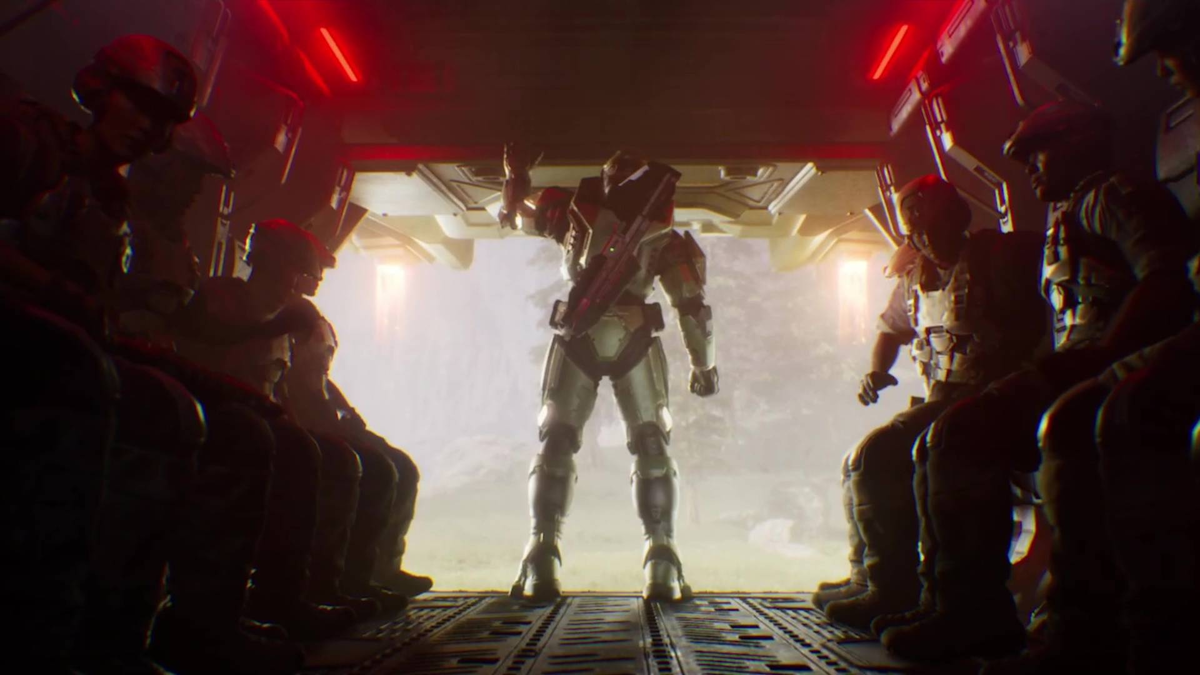
Halo: Campaign Evolved's Legendary ending finally gives Avery Johnson a survival moment: Johnson is not crushed by the exploding Halo ring in the remake's version of the original cutscene, but watching that cutscene on a handheld device before walking to a Pelican and escaping.
That change quietly repairs one of the most persistent Halo continuity wrinkles. In the original Halo: Combat Evolved, Johnson disappears in the Legendary ending; in Halo 2, he returns alive and apparently unharmed. Now the remake makes the escape part of the in-game story, not just something fans had to reconcile from a novel.
Halo: Campaign Evolved launched July 28 on PlayStation 5, Windows PC, and Xbox Series X|S, after premium edition early access began July 23. The game is Halo Studios' remake of the 2001 original, and this ending detail is small enough to miss if you are only watching for updated visuals, but big enough to matter to longtime players.
A Legendary Ending That Rewrites Avery Johnson's Fate
In the original Halo: Combat Evolved, Legendary difficulty unlocks a special ending sequence. After Master Chief and Cortana escape on a Longsword, the camera cuts to Sergeant Avery Johnson wrestling an Elite on the ring as explosions rip through the structure. Johnson tells the Elite, "This is it, baby. Hold me," and the two embrace as the Halo ring falls apart around them.
That image has followed the series for nearly 25 years because it made Johnson look dead, then made him alive in the next game. The answer existed in Eric Nylund's 2003 novel Halo: First Strike, where Johnson and a handful of other survivors escape in a Pelican. For many players, though, the books were never the same kind of proof as a scene in the game itself.
Campaign Evolved's rewrite changes the camera angle first, then changes the meaning. Johnson is still wrestling the Elite, but the shot pulls back to reveal he is watching the old cutscene on a handheld device. "Those were the days," he says, and the remake treats the original ending as footage from the past rather than the present.
"Those were the days," Avery Johnson says after seeing the old Legendary ending play out on a handheld device.
The new beach scene then does what the old one could not. Johnson is relaxing with a cigar and a sandwich while the ring reactors begin to blow up. "Oh, shit," he says. "Well, that's my cue." A Pelican flies in, lands nearby, and Johnson heads toward it as the world burns behind him.
The final touch is the one that feels most like a direct message to the audience. Johnson looks toward the camera and says, "See you in the sequel." It is cheeky, but it also reframes the remake as part of an ongoing Halo timeline rather than a museum piece. It gives players the old moment they remember and then quietly adds the missing middle.
Why Johnson's Survival Matters to Halo's Timeline
Johnson's escape is not just a neat continuity patch. It changes how players understand one of Halo's earliest tonal shifts. Halo: Combat Evolved often feels like a military science-fiction survival story: isolated, practical, and grounded in the fear that the next explosion might be the last one. Campaign Evolved keeps that shape, but its new ending gives the cast a little more room to breathe after the disaster.
The remake's joke works because Johnson has always been the character who punctures Halo's grand mythic mood. Chief is the super-soldier icon, Cortana is the digital enigma, and the Elite becomes the tragic mirror of humanity's enemy. Johnson is the guy who can stand next to apocalypse and make it sound like a bad road trip. His survival has to feel human, not just heroic.
That human quality matters because Halo 2 needed Johnson alive. The sequel pushed harder into a sprawling war story, with multiple factions, new characters, and a more operatic sense of destiny. A dead Johnson would have left a practical gap in the UNSC side of the story. Campaign Evolved's ending answers the logistics without stopping the larger Halo myth from expanding.
The clever part is that the remake does not overwrite the original ending so much as reframe it. The old scene still exists, complete with Johnson's doomed-sounding line, but the new camera reveal turns it into something Johnson watched after surviving. That is a much cleaner way to handle legacy continuity than simply declaring the old version wrong.
The Remake's Sequel Wink
The "See you in the sequel" line is almost certainly the kind of detail longtime fans will replay frame by frame. It looks like a tease for a Halo 2 remake in the same style as Campaign Evolved, especially because Halo is one of Xbox's marquee franchises and remakes have become a reliable way to refresh beloved games with modern hardware. The line is not a confirmation, though. It is a door left open, not a trailer playing.
That distinction matters. A remake can be built around nostalgia, but it also has to prove it can carry a modern audience. Campaign Evolved has received unusually strong praise, with Ford James calling it "one of the best remakes of all time" and saying it can work for newcomers, lapsed fans, and diehard players alike. That kind of reception gives Halo Studios more room to think beyond preservation.
The platform picture is more complicated. Campaign Evolved launched on PlayStation 5, Windows PC, and Xbox Series X|S, which is already a broader reach than many people expect from a Halo flagship. Still, Microsoft's newer platform strategy raises the obvious question: how much freedom will Halo Studios have if future remakes become part of the company's console playbook?
The Bigger Halo Remake Question
Campaign Evolved sits in the middle of a major industry move toward reissuing the past. Developers are rebuilding old games not only to preserve them, but to make them playable under modern expectations: smoother controls, cleaner visuals, better accessibility, and less friction for players who never got the original experience. Halo has seen earlier attempts to update old entries, but Campaign Evolved feels more ambitious because it is not simply reskinning a landmark.
That is why the Legendary ending change feels more interesting than a simple graphics pass. The remake is not just asking whether old fans recognize the same scenes. It is asking whether those scenes still work when the player knows more about the franchise, has played later games, and has spent years arguing about what the old ending actually meant.
For a player coming in cold, the new ending makes Johnson's survival easier to accept. For a longtime fan, it turns a continuity debate into a little moment of recognition. The camera pullback says, in effect, "Yes, we know what you remember." Then it adds, "And here is the version that fits what came next."
Halo Studios appears to be using remakes as a way to rebuild trust with the franchise's core audience. Halo 5: Guardians and Halo Infinite each tried to redefine the series in different directions, while Campaign Evolved offers a different path: return to the beginning, polish it for today, and use that foundation to reconnect players with the franchise's roots.
What Comes Next
The most reasonable skepticism is that the ending may be doing too much with too little. A Pelican landing on a beach is a clean answer, but it is also a wink wrapped in a wink. If Halo Studios leans on these moments without expanding the actual campaign or sequel plans, the result could feel like nostalgia servicing itself rather than a meaningful evolution of the series.
There is also the question of how much a remake should alter its own mythology. Halo fans are famously detail-oriented, and not every continuity adjustment will land the same way. Some players will love the direct answer. Others may prefer the mystery, or may argue that the novel already solved the problem. Campaign Evolved is trying to satisfy both instincts, which is brave and risky.
The bigger risk is timing. A "See you in the sequel" line can excite fans, but it can also raise expectations the studio may not be able to meet. Halo 2 is not just another sequel in the series; it is a divisive, beloved, and heavily discussed chapter that changed the franchise's shape. If a remake does happen, it will need more than a callback. It will need to understand why the original still divides people.
The immediate thing to watch is how Campaign Evolved performs commercially and critically. Strong numbers would make a Halo 2 remake feel less like a fan rumor and more like a strategic next step. Weak numbers would not necessarily kill the idea, but they would make Microsoft and Halo Studios more cautious about spending major resources on another high-profile rebuild.
Johnson's survival scene is a small moment, but it is the right kind of small moment for a remake. It does not derail the story. It does not rewrite Chief's victory. It simply gives one of the original game's most beloved characters a believable exit from the ring's destruction. For now, Halo: Campaign Evolved gives fans the answer they have been asking for since Halo 2 opened the door and Avery Johnson walked through it.




Comments (0)
Loading comments…