
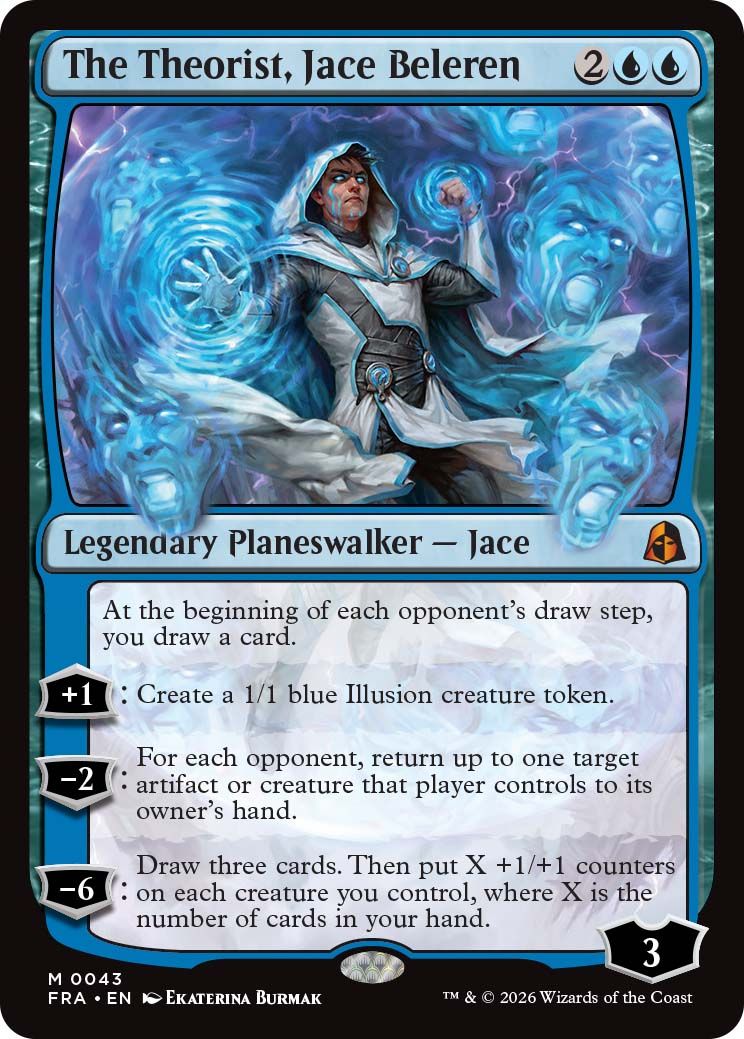
Magic: The Gathering's next story-driven set, Reality Fracture, turns Jace Beleren into a tragic, sympathetic villain — and it's the most personal and climactic story the game has told in years. Slated for release in October, the set is Magic's ultimate "What if?" scenario, reimagining iconic characters through the lens of Jace's fractured psyche after a lifetime of trauma.

Jace's Breaking Point
The set caps off a story block that began with Wilds of Eldraine after the failed Phyrexian Invasion. Jace, once a hero, has been attempting to create a reality where all the evil in the world simply doesn't exist. But as Magic's Head Designer Mark Rosewater explained at MagicCon Amsterdam, this isn't a simple turn to evil — it's an organic endpoint for a deeply traumatized character.
"The thing about Reality Fracture is that it's actually a very personal story," Rosewater told me. "How Jace gets to where he gets is all really understandable. I really love a villain you're sympathetic to."
Roy Graham, head of story for Magic, emphasized that this isn't a reimagining of Jace but a revelation of what was always there. "It requires seeing what has always been there for the character, but that he has kept a leash on," Graham said. He noted that Jace has undergone traumatic event after traumatic event — his original sparking, Nicol Bolas's manipulation, amnesia on Ixalan, being Phyrexianized — and that "it's a matter of time before you be that dramatically traumatized before, in a matter of ethics, you say, 'I'm operating on the greatest good for everybody else.'"
How the Echoverse Works
Reality Fracture presents Jace's "Echoverse" — alternate versions of beloved characters shaped by his attempts to fix their pasts. The key innovation is that each booster pack will contain both the original version of a character and its Echoverse counterpart side by side, making the "What if?" premise immediately clear even to new players.
For example, you'll find Chandra, Torch of Defiance alongside Chandra, Chill of Compliance — an Ice Mage version born from Jace keeping her father alive. This calmer Chandra ends up working for the Consulate, the very group responsible for her father's death. Similarly, Liliana the Repentant (a Black-aligned mill and graveyard recursion Planeswalker) appears with Liliana the Faultless, a White-aligned Cleric whose spark never ignited because Jace prevented her brother's death.
The most striking transformation might be Garruk, Veiled Butcher — wielding the Chainveil, he's become an interplanar serial killer, a stark contrast to Garruk, Curse Breaker. This shows the unintended consequences of Jace's unstable Echoverse.
Solving the Booster Pack Problem
Ensuring both versions of a character appear in the same pack was a significant engineering challenge. Rosewater acknowledged that "putting two cards always having them appear in the same booster is very, very hard" because booster packs have fixed slots tied to printing sheets.
While he wouldn't confirm the exact technique, Rosewater teased that the solution uses an old printing method. "I solved it in a way that we could have done twenty years ago," he said. "It wasn't that we found a new printing technique; we found a way to solve it using an old printing technique in a very clever solution."
This solves a pain point the team has faced before — ensuring every Teenage Mutant Ninja Turtles pack had a Turtle, or every War of the Spark pack had a Planeswalker.
Inside Baseball vs. New Player Accessibility
Aaron Forsythe, Rosewater's boss, initially worried the set would be too "inside baseball" — understandable only to hardcore Magic fans. The solution was the parallelism: showing both versions of a character in the same pack. "Ice Chandra doesn't mean a thing if you don't know Chandra's a Fire mage," Rosewater explained. "If you open a pack and see Fire Chandra and Ice Chandra, even if you have no idea who she is, you get it."
Not every Echoverse pair will have its mirror in the set. Cards like Craterclaw Colossus (a riff on Craterhoof Behemoth) and Enlightened Confidant (a play on Dark Confidant) are designed to be "cool in a vacuum" even without context. "Some of the time, we're going to riff on something that isn't in this set," Rosewater said. "Those things we thought were just, even if you don't understand what they're riffing on, they're kind of cool in a vacuum."
What Comes Next
Reality Fracture is a capstone set for Magic's current story block, but it's also a test of how well the game can balance its expanding audience. With millions of new players joining through Universes Beyond sets like The Lord of the Rings: Tales of Middle-earth, the team has to ensure that deeply referential content still lands. The booster pack solution and parallel card design suggest they're taking that challenge seriously.
For longtime fans, this is the payoff to years of Jace's character development — a villain you can genuinely feel for, born from trauma rather than malice. For new players, it's a visually striking set that communicates its premise in a single pack opening. That's a delicate balance, and if Reality Fracture pulls it off, it could set a new standard for how Magic tells its most complex stories.
Full disclosure: Travel and accommodation to MagicCon Amsterdam were provided by Wizards of the Coast.




Comments (0)
Loading comments…