

The barrel rolls down the girder. Jumpman leaps. The hammer swings. It's 1981 all over again, except this time the cabinet sits on your shelf, built from 1,367 plastic bricks, and the quarter slot is purely decorative.
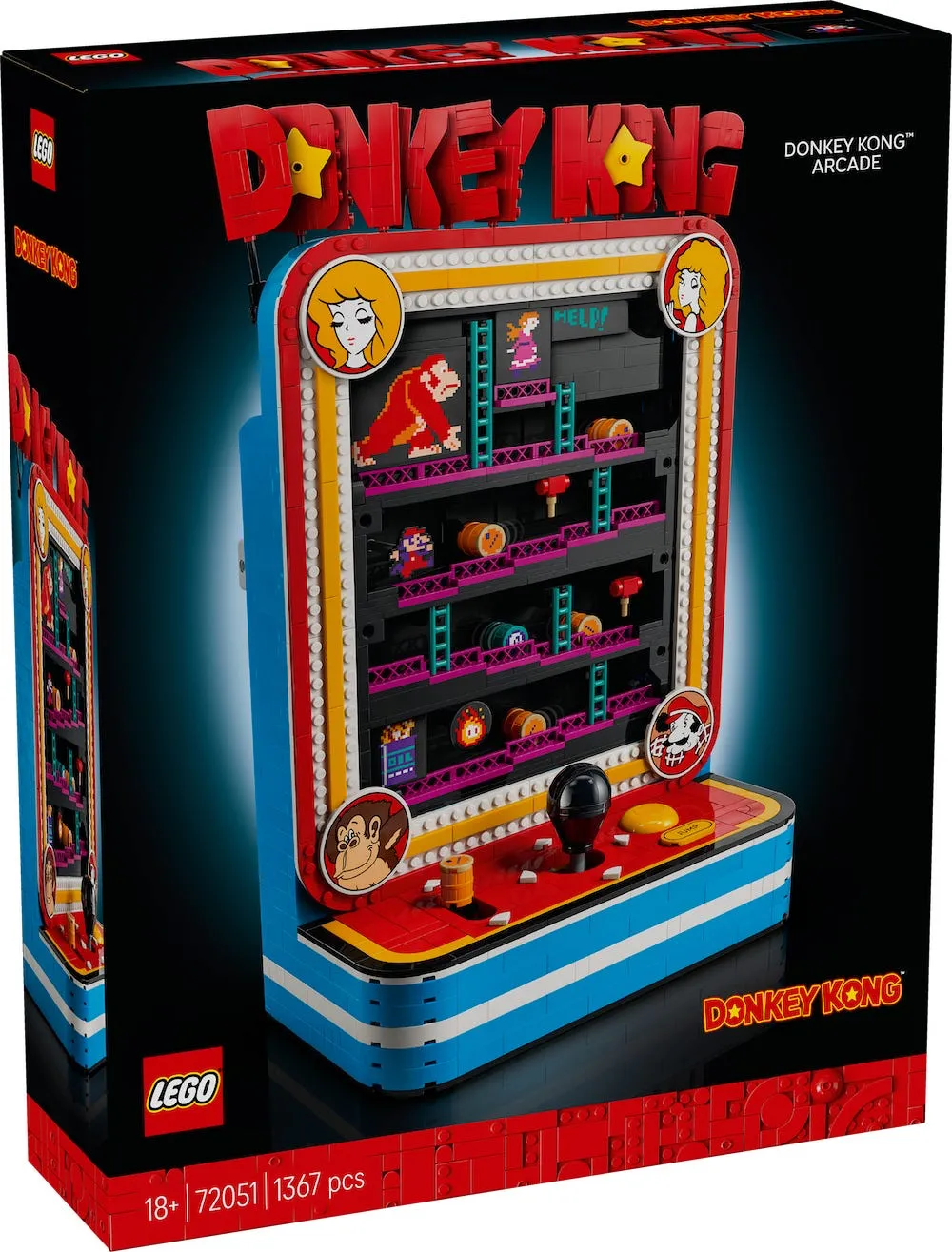
LEGO has officially unveiled its Donkey Kong Arcade set, a $199.99, 18+ model that goes on sale August 1. After a few leaks spoiled the surprise, the Danish toymaker confirmed the details: a motor-free, fully mechanical recreation of Nintendo's breakthrough coin-op, complete with a working barrel-release lever, a joystick that actually moves Jumpman across the screen, and a jump button that springs him over obstacles. There are 21 barrels in the box. A hidden conveyor system beneath the playfield cycles them from the bottom back to the top, ready for another descent.
A Cabinet That Plays Back
The build replicates the original cabinet's silhouette, down to the marquee logo and the character art on all four corners of the display bezel. Inside, the first level is rendered in brick: girders, ladders, the flaming oil drum, the hammer power-up. Donkey Kong looms at the top. Lady — the character later known as Pauline — waits on the upper platform. Jumpman, the mustachioed prototype who would become Mario, starts at the bottom.
Turn the lever, and a barrel tumbles down the ramps. Nudge the joystick left or right, and Jumpman walks. Tap the red button, and he hops. It's not electronic. There's no app, no Bluetooth, no firmware to update. The mechanism is entirely gear-driven, a kinetic sculpture that happens to be playable. LEGO designers have essentially built a mechanical arcade board out of Technic elements and standard bricks.
Why This Set, Why Now
LEGO's partnership with Nintendo has been expanding steadily since the Alien: Isolation era of licensed sets — wait, that's not right. Let me restart. LEGO's partnership with Nintendo has been expanding steadily since the Super Mario line launched in 2020. That range introduced electronic interactive bricks; the Donkey Kong Arcade set takes a different philosophy. It's a display piece that invites handling, aimed squarely at the adult collector who grew up feeding quarters into the real thing.
The timing aligns with a broader retro-hardware renaissance. Arcade1Up has sold hundreds of thousands of three-quarter-scale cabinets. Analogue and MiSTer FPGA projects keep original hardware alive. LEGO's own Icons and Ideas lines have proven that complex mechanical builds — the Typewriter, the Grand Piano, the NASA Space Shuttle Discovery — find an audience willing to spend $200-plus for engineering elegance.
What It Means for the Line
This is the largest dedicated Nintendo set since the 2,646-piece NES kit in 2020, and the first to recreate a specific arcade game rather than a console or character. If it sells well, the door opens for other golden-age cabinets: Pac-Man, Galaga, Frogger. The mechanical vocabulary established here — the barrel conveyor, the joystick linkage, the jump actuation — could be adapted for any side-scrolling or single-screen arcade title.
It also signals LEGO's confidence in the 18+ demographic. The company has quietly built a portfolio of "adults welcome" sets that rival high-end model kits in complexity and price. The Donkey Kong Arcade set sits alongside the $299.99 Rivendell and the $399.99 Eiffel Tower in that strategy.
The Skeptic's Corner
At $199.99 for 1,367 pieces, the price-per-part ratio sits around 14.6 cents — higher than the typical 10-to-12-cent sweet spot for large Technic or Icons sets. You're paying for the license, the new molded elements (the barrel, the joystick housing, the Jumpman minifigure), and the R&D on that conveyor mechanism. Whether the play value justifies the premium depends on how often you actually turn the lever versus how long it sits on a shelf.
There's also the question of durability. A purely mechanical system with this many moving parts, built from plastic gears and axles, will develop friction and wear over repeated use. LEGO's clutch power is legendary, but it's not infinite. This isn't a cabinet designed for daily play sessions; it's a conversation piece you demonstrate to visitors.
What to Watch
Pre-orders open July 20 at LEGO's store and select retailers. The August 1 release date positions it for the holiday long tail. Watch for the inevitable secondary-market spike if initial allocation sells out fast — the NES set commanded double its MSRP for months. Also watch for a potential "Player 2" expansion pack or a standalone Pauline minifigure; LEGO has a habit of monetizing completionist impulses.
More broadly, this set tests whether mechanical interactivity can become a pillar of LEGO's licensed strategy. If the barrel conveyor works as reliably in living rooms as it does in Billund, expect the technique to migrate to other franchises. A ARC Raiders set with a working grapple hook? A Ace Combat 7 cockpit with functional throttle quadrant? The vocabulary is now proven.
For now, though, it's just Donkey Kong. A gorilla. A plumber. A barrel. And a lever that makes it all happen, one satisfying click at a time.




Comments (0)
Loading comments…