

LEGO's Donkey Kong Arcade set is finally official, and you can pre-order it right now for $199.99. The 1,371-piece build ships on August 1, but the real surprise is that it's not just a static diorama — it actually lets you play a simplified version of the classic arcade game using brick-built controls. This is the first LEGO set to turn a video game into a physically interactive playset, and it's already generating serious buzz among collectors and retro gaming fans.
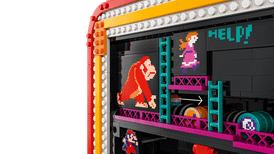
The set recreates the iconic opening screen of the 1981 Donkey Kong arcade cabinet. Jumpman (Mario's original name) climbs ladders while Donkey Kong throws barrels from above. The characters are rendered as 2D pixel silhouettes made of tiles, capturing the look of the original sprites. But the clever part is the lever and buttons on the side: a barrel lever on the left and jump and dodge buttons on the right. Pulling the lever releases a LEGO barrel down the ramp, and the buttons presumably advance the action. It's a simple mechanical game, not a digital one, but it brings the arcade experience into the physical world in a way LEGO has never done before.
The LEGO Donkey Kong Arcade set (72051) is now available for pre-order at major retailers. Ships August 1, 2026, for $199.99. #LEGO #DonkeyKong
— LEGO News (@LEGONews) July 23, 2026
What You Get for $200

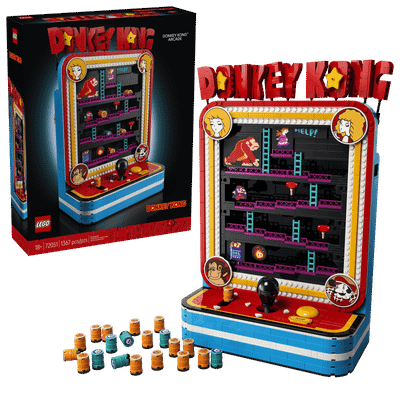
- Set number: 72051
- Piece count: 1,371
- Price: $199.99
- Pre-order now, ships August 1, 2026
- Playable features: Barrel lever, jump and dodge buttons
The set includes three minifigure-style brick-built characters: Donkey Kong, Jumpman, and Lady (the original damsel in distress). The cabinet itself measures about 12 inches tall and 8 inches wide, making it a suitable display piece for a desk or shelf. LEGO has clearly aimed this at adult collectors — the price point and piece count put it squarely in the 18+ category.
Why Now? The Nostalgia Hunger

We're in the middle of a full-blown retro renaissance. Companies like Activision have been re-releasing classic arcade compilations, and physical toys-to-life products keep finding new audiences. LEGO's own Super Mario line, which started in 2020, has been a massive hit with kids and adults alike. It was only a matter of time before they tackled Donkey Kong, the character that literally introduced Mario to the world. But the timing also reflects a larger cultural appetite: in an era where AI is generating infinite procedural worlds, the simplicity of 1981 arcade mechanics feels almost like a luxury. This set lets you unplug and interact with game history through your hands, not a screen.
There's also the growth of the "adult collector" market. LEGO has invested heavily in 18+ sets — think the Modular Buildings, the Star Wars UCS line, and now video game icons like the Atari 2600 and Pac-Man sets. The Donkey Kong Arcade fits perfectly alongside those, offering a retro cabinet that actually does something.
Deconstructing the Impact
The set's primary audience is clear: nostalgic gamers who grew up in arcades, and LEGO collectors who appreciate novel building techniques. For parents, $200 might be a hard sell for a toy that's essentially a stress ball with LEGO pieces. But for fans of the Donkey Kong franchise, this is the only way to own a physical, playable version of one of gaming's most important artefacts. The mechanical play element also gives it a lifespan beyond a single build: you can actually challenge friends to see who can "beat" the barrel gauntlet, even if the rules are self-imposed.
On the other hand, this set might cannibalise some of the digital nostalgia market. Why buy a virtual arcade collection when you can have a tactile cabinet on your desk? And for the price of a ASUS ROG Ally, you could also get a handheld PC that plays thousands of retro games. But that misses the point: this is a sculpture with function, not a gaming machine. It's about the experience of building and then watching the barrel fall, not about high scores.
A Broader Trend: LEGO's Interactive Turn
LEGO has been experimenting with interactive builds for years. The Super Mario line uses electronic sensor blocks to register when you run Mario over a course. The new Donkey Kong set takes a different approach: purely mechanical, no batteries required. That feels like a deliberate counterpoint to the digital push. Even as companies like AMD compete to render the most photorealistic worlds, LEGO is betting that there's a market for low-fi, physical simulation. It's the same impulse that drives people to build marble runs or mechanical typewriters — there's a satisfaction in seeing a cause-and-effect chain made of plastic bricks.
This also fits a pattern: LEGO is mining video game IPs more aggressively than ever. After the success of its Mario, Sonic the Hedgehog, and Overwatch sets, the company is clearly willing to take risks on older franchises. Donkey Kong isn't as evergreen as Mario, but its place in gaming history is unassailable. A Pac-Man arcade set already exists; a Space Invaders one is rumoured. The Donkey Kong Arcade could be the start of a whole sub-theme of retro arcade cabinets.
The Skeptic's Corner
Let's be realistic: $200 for 1,371 pieces is about $0.15 per piece, slightly above average for a LEGO set. But you're paying for the novelty of the play mechanism and the license. The mechanical barrel release may wear out over time, and the buttons might not feel satisfying after a dozen presses. It's also a display piece first and a toy second — the play value is arguably lower than a $60 video game. Worse, if the mechanism jams or a piece breaks, the whole "game" becomes a static model. LEGO's quality control is excellent, but moving parts always carry risk.
There's also the question of replayability. Unlike a digital arcade game, you can't add new levels or change the difficulty. Once you've pulled the lever 50 times, the novelty fades. This set lives or dies on its build experience and its shelf appeal. For many, that's enough. But if you're hoping for a genuine substitute for the original arcade, you'll be disappointed.
What Comes Next
LEGO hasn't announced any follow-ups yet, but the success of this set will likely determine whether we see more interactive arcade cabinets. A Pac-Man set with a working joystick? A Space Invaders set with a moving row of aliens? The possibilities are tempting. For Donkey Kong specifically, this could also open the door to a full Donkey Kong Country playset, or even a LEGO version of the Jungle Beat series. The new set proves that LEGO is willing to invest in the history of games, not just current hits. That's a good thing for anyone who believes that gaming culture deserves physical monuments.
For now, the Donkey Kong Arcade set is a unique object — part model, part game, part shrine to the pixelated past. Whether it's worth the price depends on how much you value the ability to touch gaming history. But for the first time, you can build the arcade, pull the lever, and watch DK's barrel roll down the ramp. And that, for a certain kind of fan, might be priceless.





Comments (0)
Loading comments…