
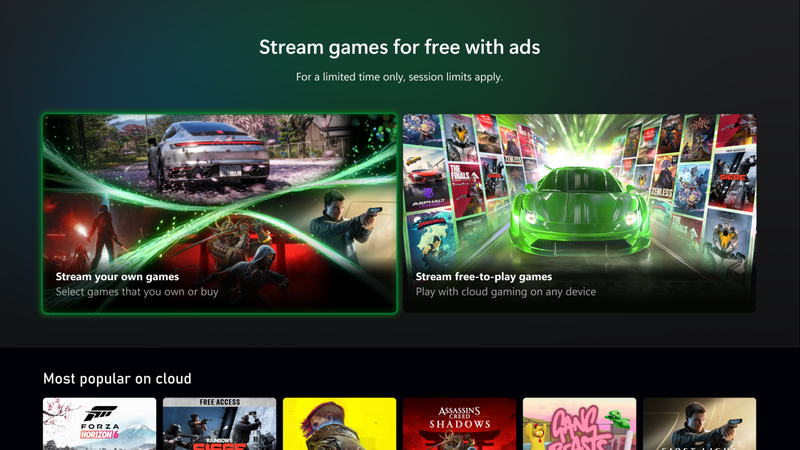
Xbox is testing a new ad-supported cloud gaming tier that lets Xbox Insiders stream games for free in one-hour sessions, with advertisements playing before each session begins. The program is optional, and Microsoft says the core gameplay experience remains unchanged — no mid-roll interruptions, no altered performance.
The Announcement
Starting this week, members of the Xbox Insider Program can opt into the experiment. Each session lasts one hour and is preceded by ads that Microsoft insists "should create value" and "hold the same quality bar as [its] content." Players can exit the test at any time and return to their existing Game Pass Ultimate or purchased-game streaming options. There's no cap on how many sessions an Insider can run, though each requires sitting through the pre-roll again.
Why This Now
Cloud gaming has been stuck in a chicken-and-egg problem for years: the infrastructure is expensive to maintain, but the audience willing to pay a monthly premium for it remains niche. Game Pass Ultimate's cloud streaming feature costs $19.99 a month — a tough sell for someone who just wants to try Starfield on a laptop or play Forza Horizon 5 on a phone during a commute. Microsoft's own data has long shown that the biggest barrier to cloud adoption isn't latency or library depth; it's price perception.
Former Xbox CFO Tim Stuart telegraphed this direction back in 2023, pointing to markets like Africa, India, and Southeast Asia where console ownership is low but mobile internet is ubiquitous. "Hey, do you want to watch 30 seconds of an ad and then get into two hours of game streaming," he said at the time. The Insider test is the first tangible step toward that vision.
Who Benefits, Who Waits
The immediate winners are curious players who've been priced out or hesitant to commit — students, travelers, anyone with a decent internet connection but no console or gaming PC. For Microsoft, the upside is audience expansion without cannibalizing Game Pass Ultimate subscriptions; the one-hour limit and pre-roll friction make this a complement, not a replacement.
Developers and publishers get a new discovery channel. A player who watches an ad to try Hi-Fi Rush for an hour might buy it later, or subscribe to Game Pass. But the revenue split for those ad impressions remains opaque. Microsoft hasn't disclosed whether studios see a cut, or if the ad inventory is sold entirely by Xbox's own sales team.
The Broader Trend
This isn't happening in a vacuum. GeForce Now has a free tier with session limits and queue times. Amazon Luna experimented with ad-supported channels before shutting down. Even Netflix Games — bundled, ad-free, mobile-first — has reportedly explored an ad tier for its cloud ambitions. The industry is converging on a freemium model: pay with time (ads, queues) or pay with money (subscriptions, purchases).
What's distinct about Xbox's approach is the integration with an existing ecosystem. An Insider who tries the ad tier today can seamlessly upgrade to Ultimate tomorrow and keep their saves, achievements, and friends list. The switching cost is near zero.
Skepticism Warranted
Ad-supported gaming has a checkered history. Remember the Burnout Paradise billboards? The NBA 2K loading-screen commercials? Players tolerate ads when they feel earned — free-to-play mobile games, ad-supported streaming tiers — but revolt when they intrude on a premium experience. Microsoft's promise that ads "hold the same quality bar as content" is easy to make now, during a controlled test with a self-selected audience. The real test comes at scale, when ad inventory pressure meets quarterly revenue targets.
There's also the question of session limits. One hour is generous for a quick session but brutal for an RPG or a competitive match that runs long. Will Microsoft sell "extend your session" microtransactions? Will ads eventually migrate mid-game? The company says participation is optional "at any time," but that framing only works if the paid alternative remains attractive.
What Comes Next
Watch the Insider feedback channels. If the ad experience feels respectful and the streaming quality holds, expect a public rollout within 6–12 months — likely starting in the regions Stuart named. Also watch whether Sony or Nvidia respond with their own ad tiers. Cloud gaming's business model is still being written, and this test is the first chapter that might actually get read by millions.





Comments (0)
Loading comments…