

Rare Famicombox Nintendo Console Found in Every Room of a Japanese Love Hotel
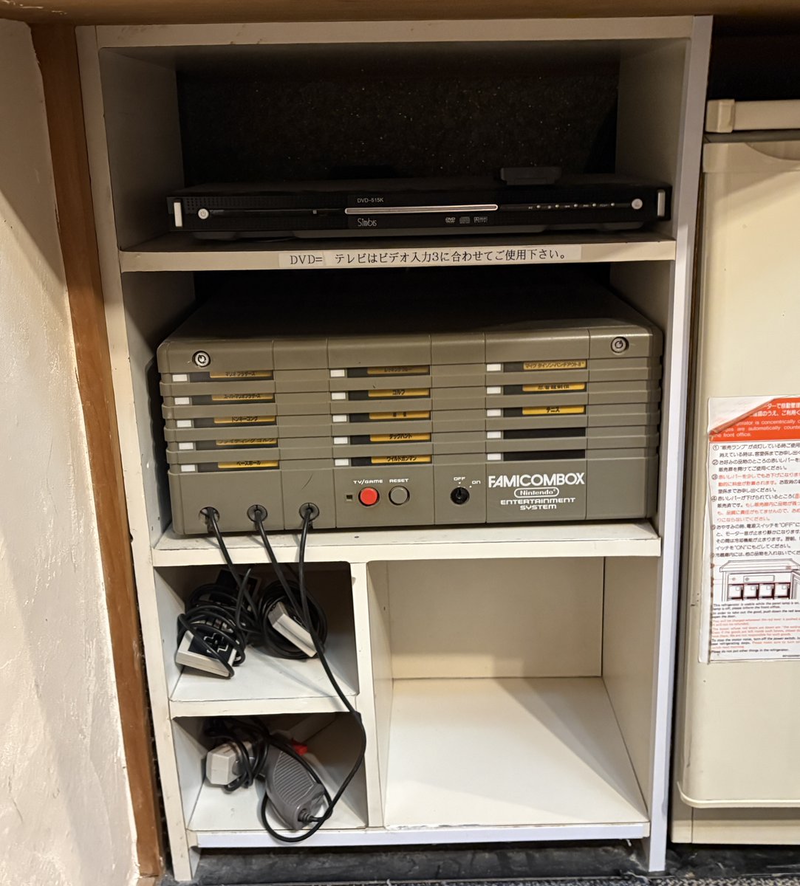
A Japanese Famicom historian has found a rare commercial Nintendo Famicombox installed and running in nearly every room of a Japanese love hotel. The hardware is not just sitting there as a prop: Orochi of the Famicom Archivist said most cartridges still worked after decades of use.
The discovery is strange because of the setting, but it is also important for preservation. This is evidence of a commercial Nintendo ecosystem that survived outside homes, arcades, and collector cases.
What Orochi found
Orochi, who posts as Famicom Archivist, reported on July 23, 2026 that a certain Japanese love hotel still had commercial-grade Famicom units in active use. According to the report, every room had one installed except for a single room.
The system Orochi found was not a normal home Famicom. It was a Famicombox, the business-use version of Nintendo’s 1986 home console. These units were built for paid play sessions, usually through keys, surcharges, or coin operation.
The first public post described the setup in practical terms: hotel-room televisions, Famicom units still running, and almost every game playable. The Zapper attachment was present, but it did not work on the LCD screens.
いまだに業務用ファミコンが現役稼働している某所ラブホテルへ潜入調査。なんと1室をのぞくすべての部屋に設置されるようだ。さっそく検証プレイ。液晶テレビにつきZAPPERは使用不可だったが、それ以外のほぼ全てのソフトが正常に遊べる夢のような場所だった。 守りたい。日本のサブカルチャー!
 View on X →
That matters more than the novelty of the location. A working Famicombox today is rare because the hardware was not sold to home consumers. Most were deployed in hotels, resorts, and similar commercial spaces, then slowly retired as televisions, consoles, and guest expectations changed.
Why the Famicombox was built for places like this
The Famicombox was designed for a very specific job: let strangers pay to play Nintendo games in a shared room without giving them a full home console. That meant locked hardware, controlled access, and cartridges that could survive repeated use.
Nintendo introduced the Famicombox in 1986, the same broad era when the home Famicom was becoming a household name. The commercial version looked different on the inside and outside, with cartridges that more closely resembled the front-loading NES design than the top-loading Famicom most players used at home.
If you traveled through the 1990s and early 2000s, you probably saw a related system in hotel TVs. The setup was often ugly, the controls were clunky, and the game selection was whatever the operator had installed. You could absolutely get walloped by Super Punch-Out!! while spending more on the session than on a mini-fridge candy bar.
The Famicombox story is basically that old hotel-TV gaming culture still has a living specimen. It is not a museum piece, and it is not a restored collector item. It is hardware doing the job it was built for.
@gucchii0925 色んな意味で体力的にムリかも知れません。笑。くっ、あと20年若ければっ!
 View on X →
The preservation angle is the real story
This is not just a weird internet story about a Nintendo console in a strange room. It is a reminder that commercial hardware often survives in places collectors never think to check.
Home consoles get restored, cleaned, boxed, and cataloged. Business-use machines get installed in hotels, left on VHF inputs, connected to dead televisions, and eventually stripped for parts. A working unit still connected to a working room setup is valuable because it preserves the full chain: console, controller, cables, power, display, and payment logic.
Orochi described the experience as “dream-like” because almost every game tested still played normally. That is the kind of real-world performance data collectors usually only get after hours of troubleshooting dead carts, bad connectors, and mismatched power supplies.
The location also explains why Orochi did not name the hotel. These hourly establishments are common in Japan and operate in a legal gray area, with sex work, affairs, and couples seeking privacy all part of the market. Publicly identifying one of them could draw attention, damage the business, or turn a preservation find into a collector treasure hunt.
The Yamauchi rumor does not need this find
The story has already revived an old rumor that former Nintendo president Hiroshi Yamauchi once managed love hotels before Nintendo became a global household name. The claim has floated around for years, usually tied to a line from David Sheff’s Game Over.
Orochi’s research did not find documentation or sources that back up the claim. That does not prove Yamauchi never had any connection to such businesses, but it does mean this hotel discovery should not be treated as evidence.
It is a useful distinction. The Famicombox finding is documented by a public post, test results, and the hardware itself. The Yamauchi rumor is hearsay with a famous name attached to it. One is a preservation find. The other is a legend that will not go away because it is too juicy to ignore.
Why this matters to collectors and historians
For collectors, the lesson is simple: rare hardware is not always hiding in attics, basements, or sealed boxes. Sometimes it is still plugged in and running in a place where nobody expected to find a museum-quality machine.
For historians, the Famicombox is a glimpse into how Nintendo’s early ecosystem extended beyond consumer retail. Hotels and resorts were part of that world. So were arcades, vending machines, rental shops, and regional distribution quirks that shaped how games were actually used.
The best part of the report is not that the hotel had a Famicombox. The best part is that the Famicombox still worked. That means the room still reflects how these systems were intended to function: locked away, paid for, used heavily, and trusted to run games without fuss.
There is also a darker side to preservation. Parts-hunters can strip old hardware for boards, copper wire, controllers, and cases. A machine left in its natural environment may be more historically valuable than one dismantled for parts, even if the parts are salvageable.
What should happen next
The next step is documentation, not tourism. If Orochi or another Famicom historian can record the exact model, power system, room layout, controller type, cartridge behavior, and room-to-room differences, this becomes a serious record of a vanishing commercial setup.
The unanswered question is how many other business-use Nintendo systems are still active in Japanese hospitality spaces. Some may be obsolete. Some may still be locked behind payment systems. Some may be in rooms that nobody is willing to open just because a retro console is inside.
That is why the location was withheld. The hardware is rare enough to study, but the setting is private enough that publicizing it could change the outcome. A good preservation find should increase knowledge, not turn a working machine into a scavenger hunt.
This is not proof of a secret Yamauchi love hotel empire. It is proof that Nintendo’s commercial hardware survived in unexpected places, still functioning in a world that moved on decades ago. For anyone who cares about old consoles, that is the better story.
いまだに業務用ファミコンが現役稼働している某所ラブホテルへ潜入調査。なんと1室をのぞくすべての部屋に設置されるようだ。さっそく検証プレイ。液晶テレビにつきZAPPERは使用不可だったが、それ以外のほぼ全てのソフトが正常に遊べる夢のような場所だった。 守りたい。日本のサブカルチャー!
View on X →




Comments (0)
Loading comments…