

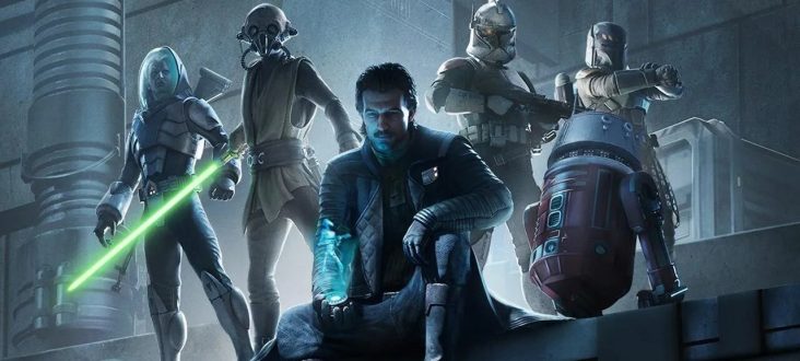
In a gaming landscape increasingly obsessed with player choice, romanceable companions, and branching narrative trees, one developer is saying something almost radical: our game just tells a straight story. Bit Reactor, the studio behind the upcoming tactical title Star Wars Zero Company, has confirmed that the game's narrative "is a linear one from beginning to end." No branching paths. No romance options. No dialogue wheels that reshape the galaxy. Just a focused, authored story set in the Star Wars universe.
That might sound like a throwback, but in context, it's a deliberate design bet — and one with real market logic behind it.

A Return to Authored Storytelling

Speaking in a recent interview, Bit Reactor's team made clear that Zero Company is a tactical strategy game first and a narrative experience second — but that doesn't mean the story is an afterthought. It means the writing team built a script with a fixed beginning, middle, and end, designed to support the gameplay loop rather than split off into a dozen variations. "We want players to experience a cohesive Star Wars story," the developer said, "not manage a relationship chart."
For anyone who has watched the industry swing hard toward sprawling, choice-driven epics — Baldur's Gate 3, Cyberpunk 2077, Mass Effect — this might feel like a step backward. But Bit Reactor is betting that not every game needs to be a relationship simulator. Sometimes you just want to command a squad of rebels and blow up an Imperial base without worrying about whether your squadmate is about to dump you.
The decision also reflects a practical reality. Developing branching narratives is expensive. Recording multiple voice takes, writing alternate scenes, and testing every permutation inflates budgets and development cycles. For a mid-sized studio like Bit Reactor, a linear story means more resources spent on the tactical systems and mission design — the parts of the game that will actually differentiate it in a crowded market.
Why This Now

The timing of this announcement matters because it arrives during a broader industry recalibration. For years, the AI-driven promise of "infinite narrative" and procedurally generated quests dominated developer roadmaps. Investors wanted to see player choice metrics. Publishers wanted to sell "replayability." But recent data from Alinea Analytics suggests that the majority of players in tactical strategy games — the core audience for Zero Company — complete the campaign once and move on. Branching paths in these genres rarely justify their production cost.
Meanwhile, the Star Wars license itself has seen mixed results with narrative experimentation. Star Wars Jedi: Fallen Order told a linear story with minimal player agency and was a critical and commercial hit. Star Wars Outlaws, which promised an open-world with branching faction relationships, launched to mixed reception and underwhelming sales. The pattern suggests that Star Wars fans may value tone and authenticity over narrative flexibility.
Bit Reactor seems to have internalized that lesson. By stripping away romance and branching, they're focusing on what a tactical game does best: systems, positioning, and tension.
Deconstructing the Impact
For players who grew up on XCOM and Fire Emblem, this is good news. Those games succeed because their narratives serve the gameplay, not the other way around. A tight, linear story with a clear antagonist and set piece moments can be more memorable than a sprawling web of half-developed threads. The Ace Combat 7: Skies Unknown proved that a linear narrative with strong cinematic direction can still resonate emotionally even without player choice.
For the other camp — players who loved the romance trees in Fire Emblem: Three Houses or the faction politics in Triangle Strategy — this is a letdown. Romance in tactical games has become a beloved subgenre feature. Removing it entirely means alienating a segment of the audience that enjoys the social layer as much as the combat layer.
Bit Reactor's gamble, then, is that the tactical mechanics and Star Wars atmosphere will be strong enough to carry the experience. If the game's systems are deep enough and the story is well-written, the lack of branching may go unnoticed. If the story fumbles or the combat feels shallow, the absence of choice becomes a glaring flaw.
The Broader Trend
Zero Company is not an outlier. A quiet counter-trend is forming against the "everything must branch" orthodoxy. Alien: Isolation, a game with almost no narrative branching, remains the gold standard for licensed horror. Animal Well — a metroidvania with zero dialogue, let alone romance — became one of the most-discussed indie games of the year. Players are increasingly showing that they value craft over complexity.
That doesn't mean branching narratives are dead. The AI arms race in dialogue generation and procedural storytelling is still accelerating, especially at the AAA level. But for studios with finite resources, the calculus is shifting. A linear story executed well can deliver a more satisfying experience than a branching story executed unevenly. Bit Reactor is making a bet that fits their scope and their genre.
There's also a practical concern: romance in a Star Wars game set during a conflict period can feel forced. Not every squad needs a will-they-won't-they subplot. Sometimes the stakes of the mission are enough. The Alwa series proved that a focused adventure without romantic subplots can build a dedicated fanbase purely on level design and atmosphere. Bit Reactor might be hoping for the same outcome.
A Skeptical Eye
That said, linear narratives in licensed games have a poor track record. Too often, "linear" becomes code for "on-rails" — a series of cutscenes strung together by corridor combat. The worst-case scenario for Zero Company is that it becomes a forgettable tie-in, a game you play once, enjoy mildly, and never think about again. Without branching paths, the game has fewer reasons for replay. If the tactical depth isn't there, the campaign will feel thin.
Bit Reactor hasn't shown enough gameplay footage yet to fully assuage those fears. The promise of a linear Star Wars tale sounds good in theory, but execution is everything. Players remember Star Wars: Squadrons for its tight flight mechanics, not its plot. If Zero Company lands on the right side of that balance, it will be a success. If it leans too hard on the license and not enough on the systems, it will join the pile of games people forget they played.
What Comes Next
Bit Reactor hasn't announced a release date for Star Wars Zero Company, but the team has confirmed more gameplay reveals later this year. The tactical strategy space is getting crowded — ARC Raiders, Absolum, and other titles are all targeting similar audiences. Zero Company needs to differentiate itself. A linear Star Wars story, confident and well-paced, could be exactly that.
For now, the industry will be watching to see if this bet pays off. If it does, expect more mid-sized studios to follow suit. If it doesn't, the romance chart will live to branch another day.




Comments (0)
Loading comments…