

If you've been searching for a survival game that actually makes you feel like you're stranded somewhere that wants you dead, Blind Descent is the real deal — and it took me less than 10 minutes with the demo to know this was going to be my next obsession. Developer Pokuch's upcoming Steam Early Access title, which blends the deep-sea terror of Subnautica with the grounded, hostile wilderness of The Forest, has already amassed over 300,000 wishlists on Steam. After playing it, I fully understand why.
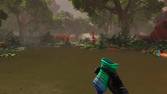
The premise is a clever twist on the stranded-survivor formula. Instead of waking up on a beach or in a forest, you crash-land deep beneath the surface of Mars while investigating a lost pioneer team. The surface of the red planet is nowhere to be seen — you're trapped in a sprawling subterranean world of thick alien jungles, bioluminescent caves, and violent weather systems that make the surface look like a vacation destination by comparison. Alone or with up to three friends in co-op, you gather resources, craft gear, build a base, and try to figure out what happened to the previous expedition. The hook is immediate: this isn't the barren Mars you've seen in movies. It's an alien ecosystem that feels alive, hostile, and deeply indifferent to your presence.
Atmosphere Is Everything, and Blind Descent Nails It
The most important thing a survival game can get right isn't its crafting tree or combat system — it's atmosphere. You can have the most detailed hunger meter in the world, but if the world itself doesn't feel threatening, none of it matters. Blind Descent understands this at a fundamental level. Within moments of starting the demo, I felt that familiar tension that only the best survival games deliver: the sense that I was a foreign object in an ecosystem that was about to reject me.
During the day, the environment is beautiful in an alien way — towering strange flora, pools of glowing water, creatures that keep their distance but watch you closely. You spend your time doing what any survival veteran would: chopping down trees, scanning plants and animals, building a small shelter where you can boil water and cook food. The crafting loop is satisfying and familiar, but the world itself keeps you curious. There's a strange corruption spreading through the area, a mystery that pushes you forward. But nightfall changes everything.
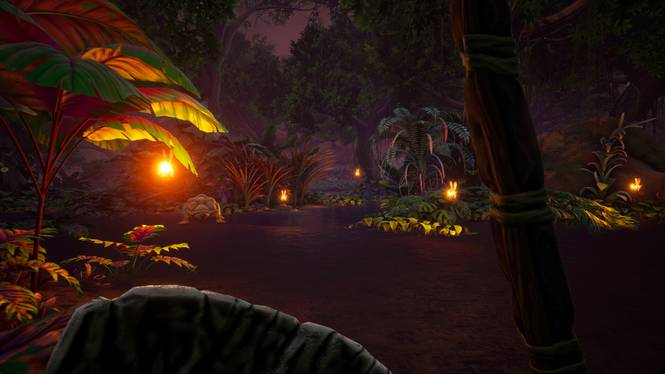
When the sun goes down, Blind Descent becomes almost oppressively dark, even with a light source in hand. The silhouette of a creature moving at the edge of your vision is enough to freeze you in place. The constant ambient sounds — calls, rustling, movement — keep the world feeling alive without ever telling you whether what you're hearing is friendly or about to make you its next meal. The game isn't trying to be a straight horror title, but the horror is baked into the premise. It's there in the darkness, in the shadows you can't quite see through, and in the caves you're forced to enter where there's no guarantee you'll make it back.
Science or Mutation: A Meaningful Choice
What sets Blind Descent apart from other survival games at a mechanical level is the branching path between technology and mutation. You can either rely on advanced tech — building better tools, scanning equipment, reinforced shelters — or you can begin mutating your own body to adapt to the hostile environment. It's a genuine choice that changes how you approach every challenge, and it gives the game a role-playing depth most survival games don't bother with. Do you trust your machines, or do you become something other than human to survive?
The scanning system deserves a special mention. You study alien flora and fauna to learn their behaviors, weaknesses, and potential uses. It adds a layer of curiosity and discovery that feels pulled directly from Subnautica's DNA — every new creature is either a resource, a threat, or both, and the only way to find out is to get close enough to scan it. That uncertainty is where the tension lives.
The survival genre on Steam has become an increasingly crowded space, with developers chasing the success of giants like Subnautica and The Forest. But most of those imitators copy the mechanics without understanding what made those games special: the atmosphere, the mystery, the sense that you're not just managing meters but actually exploring a place with secrets. AI-driven procedural worlds and smarter creature behavior are now pushing the boundaries of what indie survival games can do, and Blind Descent appears to be riding that wave effectively. The ecosystem here doesn't feel static — it reacts to you, and you never feel entirely in control.
Early Access Means Rough Edges — And That's OK
Of course, Blind Descent isn't perfect in its current state. The demo shows real promise, but it also reveals areas that need work. Some animations feel stiff, the UI could use refinement, and the combat — while functional with melee and ranged options — lacks the weight that would make every encounter feel truly dangerous. These are exactly the kinds of issues that Early Access is designed to address, and Pokuch has been transparent about listening to feedback. The wishlist count suggests there's a large community ready to help shape the game's future, which is a good sign.
There's also the broader question of whether Blind Descent can sustain its mystery over the long haul. The demo gives you a taste of the world and its central puzzle — what happened to the missing expedition? — but open-world survival games often struggle to deliver satisfying conclusions. Subnautica managed it because its story was tightly woven into the exploration loop. The Forest had a narrative payoff that justified the hours of building. Blind Descent has the setup, but it needs to deliver on the payoff. The AI arms race in game development has raised player expectations for intelligent, reactive worlds — and that's a high bar to clear.
In many ways, Blind Descent represents the best of what the indie survival scene can offer: a creative premise, strong atmosphere, and a developer clearly passionate about the genre. Major publishers like Activision have largely stepped back from the survival space, leaving room for smaller teams like Pokuch to fill the gap with more experimental, player-driven experiences. And on the hardware side, running the demo smoothly on mid-range AMD hardware without issues suggests the game is being built with accessibility in mind — not just for those with top-tier rigs.
What Comes Next for Blind Descent
Pokuch has a roadmap ahead for Early Access, with planned updates that expand the crafting systems, add new biomes, flesh out the story, and refine the creature AI. The demo is available now on Steam for anyone who wants to see for themselves whether this underground Martian world is as compelling as it looks. If the full release builds on the foundation shown in the demo — deepening the mystery, tightening the combat, and maintaining that suffocating atmosphere — Blind Descent could easily become one of the defining survival games of the next few years.
For now, I'm just trying to work up the courage to go back into those caves. The demo ended and I wanted more, which is exactly the feeling every good survival game should leave you with. Blind Descent has the bones of something special. Now it just needs to survive the journey to full release.



Comments (0)
Loading comments…