
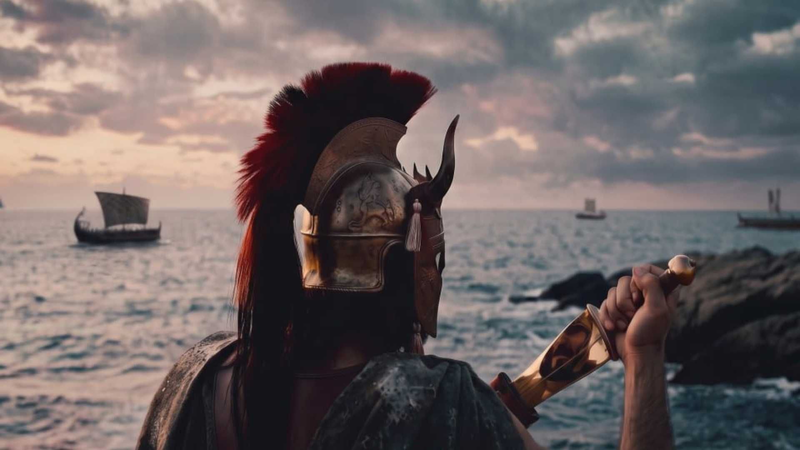
Two projects named The Odyssey are heading toward audiences—one from Christopher Nolan, the other from a collective of AI filmmakers. And despite what the internet might tell you, there’s no beef.
The AI filmmaking team behind their own The Odyssey—a short film generated entirely by machine learning models—issued a statement this week clarifying that they have no intention of competing with Nolan’s upcoming adaptation of Homer’s epic. “We are not in a rivalry with Christopher Nolan,” the group wrote. “His work is foundational to modern cinema. Ours is an experiment in a different medium entirely.”
The Odyssey: Two Very Different Visions
Nolan’s The Odyssey was announced earlier this year as his follow-up to Oppenheimer, with reports emphasizing his commitment to practical effects, large-format IMAX cameras, and a traditional production pipeline. It’s exactly what you’d expect from a director who famously blew up a real house for Tenet and built a functional nuclear reactor set for his last film.
The AI version, by contrast, was created by a small collective of researchers and artists who used generative video models to produce a 15-minute visual interpretation of the poem. No actors, no physical sets, no cameras. The result is a fluid, dreamlike sequence of imagery that the team describes as “a meditation on memory and storytelling through synthetic means.”
When both projects surfaced within weeks of each other, online discourse quickly framed them as opposing forces—practical vs. digital, human vs. machine, old guard vs. new wave. The AI filmmakers say that framing misses the point entirely.
Why the Rivalry Narrative Took Hold
Nolan has been vocal about his skepticism toward AI in filmmaking. In a 2023 interview, he called generative AI “a threat to the craft of filmmaking” and warned that studios might use it to cut costs at the expense of artistry. That stance, combined with his reputation as a champion of practical effects, made him an obvious counterpoint to any AI-driven project.
The AI collective’s The Odyssey happened to be in development long before Nolan announced his version. “We were deep into pre-production when the news broke,” the statement continues. “Suddenly our small research project was being positioned as an antagonist to one of the greatest living directors. That was never our intention.”
The timing created a perfect storm for a narrative that the filmmakers never wanted. Social media latched onto the coincidence, with some fans even calling for a direct comparison between the two works—a comparison the AI team says is meaningless given the radically different formats and goals.
“We are not trying to replace Nolan’s vision. We are asking what a myth looks like when it’s told by a machine that has never seen the ocean but has read every description of it ever written.”
That quote, from the collective’s lead researcher, cuts to the heart of their project. They aren’t trying to outdo Nolan at his own game; they’re exploring an entirely different set of tools for an entirely different kind of storytelling.
The Clarification
The statement goes on to outline specific points of distinction. The AI The Odyssey is a short film, not a feature. It will be released for free online rather than in theaters. And its production timeline was dictated by research funding cycles, not by any attempt to beat Nolan to the punch.
“We admire Christopher Nolan immensely,” the statement reads. “His insistence on tangible, physical filmmaking is part of what makes his work so powerful. Our approach is complementary, not competitive. We believe there is room for both.”
That sentiment may sound diplomatic, but it reflects a genuine tension in the industry right now. Studios are experimenting with AI tools while unions fight to protect human jobs. Directors like Nolan and James Cameron have voiced concerns, while others like the Russo brothers have embraced AI for certain tasks. The AI filmmakers are trying to carve out a space that doesn’t threaten the traditional craft—but that’s a difficult line to walk when the technology itself is so disruptive.
What This Says About AI in Hollywood
The rivalry narrative isn’t just about two projects with the same name. It’s a symptom of a larger anxiety: that AI will eventually replace human filmmakers entirely. That fear is understandable, but it also obscures the reality that most AI film projects today are experimental, low-budget, and far from mainstream.
Generative video tools have improved dramatically in the past two years—OpenAI’s Sora, Runway’s Gen-3, and others can produce convincing clips from text prompts—but they still lack the coherence and intentionality of a human-directed film. The AI The Odyssey is a 15-minute sequence of shifting, surreal imagery. It’s not a narrative film in the traditional sense, and the collective is upfront about that.
What they’re doing is closer to a visual essay or a piece of generative art than a movie. By framing it as an experiment rather than a competitor, they’re hoping to lower the temperature of the debate. But the industry’s reaction to their project—and to the very idea of an AI-generated Odyssey—shows how charged this moment is.
Both Odysseys Ahead
Nolan’s The Odyssey is expected to begin production next year, with a release likely in 2026. The AI version is set to premiere at a small digital arts festival this fall, followed by a free public release. Neither project will interfere with the other’s timeline or audience.
The AI filmmakers say they plan to watch Nolan’s film when it comes out. “We’re genuinely excited to see what he does with the material,” the statement concludes. “If anything, his version will give us new ideas to explore.”
For now, the two Odysseys exist in separate worlds—one built from IMAX cameras and practical sets, the other from neural networks and training data. Whether they can coexist peacefully depends less on the filmmakers and more on an audience that’s still deciding how it feels about machines telling stories.


Comments (0)
Loading comments…