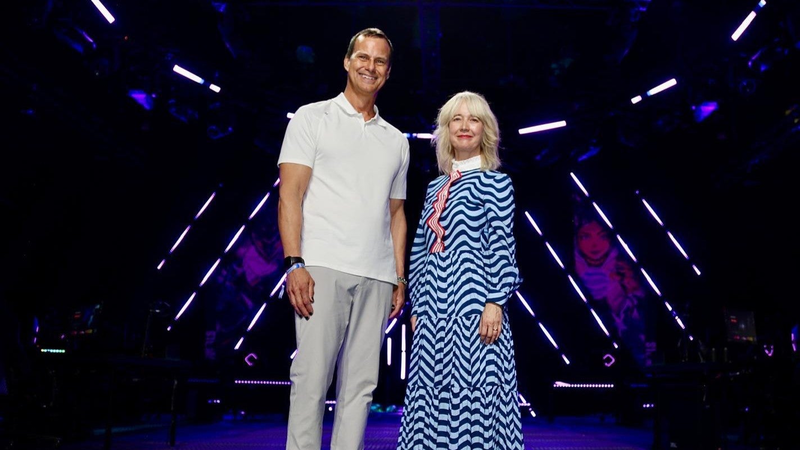
Last month, London hosted the Valorant Masters, one of the biggest dates in the calendar for Riot Games' tactical shooter. This isn't the first time that the city has hosted big esports shows. In 2024, London was the venue of the League of Legends World Championship, while last year the UK capital hosted the Blast Premier London Open, a Counter-Strike event. It's a deliberate strategy: City Hall wants London to be "the destination of choice for esports," says Justine Simons OBE, the deputy mayor for culture and the creative industries. "We know it's an area that's growing super fast," she says. "The global audience is 640 million, and it's predicted to be worth $10 billion by 2033. This is a huge opportunity. It's something that has been growing and growing over the last decade, certainly in the last few years." The character Gekko from Valorant | Esports is just one arm of London's strategy for video games, sitting alongside the millions that the Mayor of London has invested in the sector, usually via Games London, which runs the London Games Festival. "It's all part of a bigger strategic story," Simons argues. "It's not something that's jumped out of nowhere. We've been on this for a decade, really. What's clear is that it's really starting to pay off now." She adds that London is already the biggest European city for esports, but says that City Hall isn't looking to rest on its laurels. The planning process On Riot's side, the planning for an event begins between 18 and 24 months beforehand. "We have four big regions where we rotate our international events: the Americas, EMEA, South East Asia and Korea, and then China," explains John Needham, president of publishing and esports at Riot Games. "We try to balance regions across all our esports so we're not in the same region with all our esports at the same time." John Needham | "We start looking at player density in cities," Needham continues. "We have a lot of data on how many players we have." After that, Riot looks at "access", which Needham says is "great" for London. "It's so accessible across all of Europe." Then the next step is venues, which is generally when the cities themselves become involved in the process. "These days, cities will really lean in to help and give us areas where we can do fan activations, to help us promote the event around the city," Needham says. "But mostly it's about player density and accessibility for other players to come participate in our event." As Riot gets closer to its events – about a year out – the company starts to look at what is happening in the game. "We leverage our esports events as platforms to do big game announcements," Needham says. "We want them to be these big moments for our players where a bunch of different things come together: music, consumer products, esports, and game announcements. We deliver these really memorable moments for our players. We'll start looking at that, at the thematics that are going to be happening in the game, and then we'll start building our broadcast kits and what we actually need to produce the event." Then, a month out, Riot ramps up the marketing to build excitement going into the show; not just the matches, but also the other content at the event. "We have four big regions where we rotate our international events" "We'll start building all this momentum going into what players will see going into the weekend," Needham says. "When you come to one of our big international events, there'll be a fan activation area. Our sponsors will be there activating. We have an artist alley where some of our more skilled artists in our community will come and be able to sell their art there, we'll do press days." And then, the day arrives. Members of Riot's games team typically make some big announcements, "and then we'll showcase the best players in the world competing for a championship," Needham says. "It's very much this holistic, unified experience that we try to deliver to our players. It's a cultural moment where we strengthen our relationship with them and make them proud to be a part of our community." Impact These shows, in addition to being a huge showcase for the games and companies in question, are also a sizeable economic boon to the host city. Simons cites data from City Hall showing that the League of Legends World Championship generated £12 million in economic impact and reached 50 million people globally. The Counter-Strike Blast Premier London Open generated £30 million and was watched by 89 million gamers around the world. But the economic impact is only one part of the story. "You've got the economic potential, but also reputationally, this is us speaking to the world," Simons says. "This is a way in which we can communicate to the rest of the globe what a dynamic and creative capital we are. Then the value is in the jobs, because they generate lots of jobs. Then there's the wider impact – hospitality, hotel rooms." London hosted the Valorant Masters final in June | The O2 Arena, which hosted the League of Legends World Championship finals in 2024, has a capacity of 20,000 people. The venue for the Blast Premier London Open – OVO Arena Wembley – can hold 12,500 people, while Copperbox, where Riot recently held the Valorant Masters final, holds between 6,000 and 7,481 attendees. Even if these venues were at capacity, the numbers in the room would still only represent less than 1% of the total audience. But this isn't a problem as far as Riot and London's City Hall are concerned. "These events are a great way for us to reach a global audience" "We draw a lot of tourism," Needham explains. "There's lots of research that shows the benefit to the local economy. When you watch our broadcasts, we'll showcase a lot of local culture and a lot of the local sights in the area. Cities see this; they can see this is a way for them to promote broader tourism to a very valuable young audience. There's a lot of value there for cities." Simons adds: "These events are a great way for us to reach a global audience to show that London is an exciting, dynamic, and creative place. Also, as an audience, all demographics play games. In esports, a big portion of the audience is under 30. It's a brilliant way for us to reach that community globally and project our values. London is open, it's diverse, it's inclusive, you can be yourself here, all those values are present in the games community." She concludes: "It's a very inclusive, community-spirited industry, which really chimes with our values as Londoners."
As an Amazon Associate we earn from qualifying purchases. Some links on this page are affiliate
links — if you click through and make a purchase, we may earn a commission at no extra cost to
you.





Comments (0)
Loading comments…