
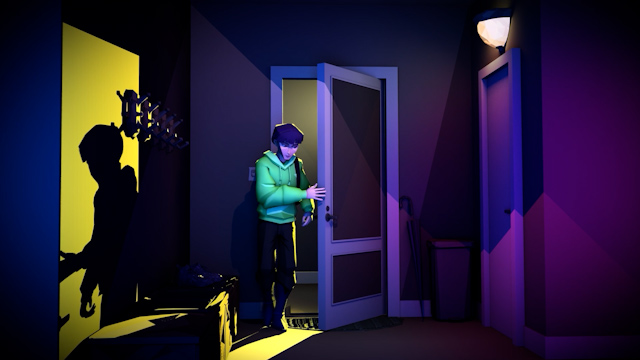
Another detective game where you actually have to think like a detective — not just click through dialogue trees until the solution falls out — is opening its beta this week. Hope in the City puts you in the worn sneakers of Hope Song, a 17-year-old artist investigating her parents' disappearance by sketching observations in a notebook and connecting them into insights. The beta sign-up is live now on Steam.
The announcement dropped quietly: a playtest window for a non-linear narrative mystery that blends angular low-poly visuals with a mechanic that treats deduction as a creative act rather than a logic puzzle. You gather observations — a scuff mark, a half-erased name, the way light hits a windowsill — and render them as sketches. Those sketches become nodes in a growing web of understanding. When the pattern clicks, the game doesn't hand you the answer. You realize it.
Why the Sketchbook Matters

Most mystery games fall into two camps: the Ace Attorney model where you present evidence at the right prompt, or the Her Story model where you search a database until the narrative coheres. Hope in the City tries a third thing. The sketchbook isn't a menu — it's the investigation itself. Your drawings are imperfect, personal, and they accumulate. A doodle of a fire escape from hour one might reframe a witness statement in hour four. The game trusts you to notice the connection before it does.
That trust is rare. The last few years have seen a quiet renaissance in deduction design — Return of the Obra Dinn made you cross-reference crew manifests with death scenes, The Case of the Golden Idol turned frozen tableaux into logic grids, Paradise Killer let you accuse the wrong person and live with it. Hope in the City sits in that lineage but swaps the spreadsheet for a sketchpad. The low-poly art style isn't just aesthetic; it abstracts the world just enough that observation becomes interpretation. You're not pixel-hunting. You're deciding what matters.
The Non-Linear Promise

Non-linear is a word that gets thrown around. Here it means the investigation doesn't gate progress behind a single correct sequence. You can chase the art dealer lead first, or the neighbor's testimony, or the strange symbol in your father's studio. The notebook restructures itself around whatever you've found. Breakthrough moments — the game's term for when observations crystallize into actionable insights — can happen in different orders for different players. That's ambitious. It's also the kind of design that either sings or collapses under its own complexity. The beta will tell which.
"The bold art style blends story and visuals into a unique world where Hope's artist's eye helps you piece together clues. Unique thought-based gameplay mechanics transform observations into actionable insights as you dig deeper into what happened."
That's the pitch. The reality of balancing 17-year-old Hope's personal stakes — her grief, her anger, her determination — against a systems-driven investigation is the real test. Narrative games with systemic cores often struggle to make the two halves speak the same language. When they do, you get Disco Elysium. When they don't, you get a clever mechanic wrapped in a story that feels like flavor text.
Where This Fits
The indie mystery space has been quietly eating the genre's lunch. AAA detective games — L.A. Noire, the recent Sherlock Holmes entries — still lean heavily on scripted sequences and fail states. Indies have embraced the idea that deduction is satisfying precisely because it can't be failed, only delayed. Hope in the City arrives alongside titles like Immortality and The Roottrees Are Dead in pushing the form toward player-authored understanding. The sketchbook mechanic is its distinct claim in a crowded conversation.
There's also the matter of perspective. A teenage girl protagonist who processes trauma through art isn't the genre's default. The industry still treats that demographic as niche. Games like Life is Strange and The Longest Road on Earth have proven there's an audience for quiet, observational storytelling about young women, but the detective frame adds structural rigor to what could otherwise drift into walking simulator territory. The mystery gives the observation purpose. The art gives the mystery texture.
Reasonable Skepticism
Playtests are where ambitious systems go to die. The sketchbook's flexibility — its greatest strength — is also the hardest thing to balance. If players can connect anything to anything, the insight moments lose weight. If the game subtly guides connections, the illusion of discovery fractures. The non-linear structure multiplies the testing burden exponentially. A four-hour playtest won't reveal whether the third-act revelation still lands when a player took the "wrong" path first. The developers at Adorable Arts (a studio worth watching, by the way — their earlier work shows a consistent interest in expressive, personal storytelling) have their work cut out.
And the low-poly style, while striking in screenshots, has to carry emotional weight in motion. Angular faces can read as blank. Environmental storytelling in a style that abstracts detail requires exceptional composition. These are solvable problems, but they're not solved in a press release.
What to Watch For
The beta runs for a limited window — sign-ups are open through Steam, and the playtest client should land in libraries shortly after. If you're curious about where deduction design is heading, this is one to actually play, not just watch. The sketchbook mechanic either clicks for you in the first hour or it doesn't. There's no middle ground.
More broadly, Hope in the City represents a strand of indie development that treats genre conventions as suggestions. The detective game doesn't need a trench coat, a rain-slicked city, or a grizzled voiceover. It needs a question worth answering and a system that makes the answering feel like yours. Hope Song has her sketchbook. The rest is up to us.




Comments (0)
Loading comments…