
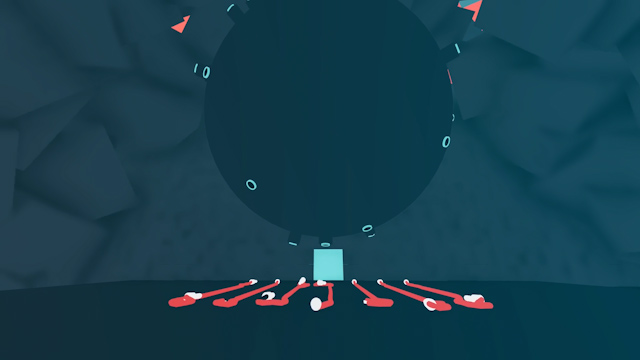
The Noodle Cable beta demo is live on Steam right now, dropping you into a first-person physics puzzler where the entire premise is untangling massive cables across fifty surreal brutalist rooms without letting a single wire touch the floor or another cable.
Developed by a small team under the fictional Noodle Cable Technologies banner, the demo serves up a concentrated dose of spatial reasoning wrapped in environments that feel like 13 Sentinels: Aegis Rim collided with a brutalist architecture showcase. Each room is a self-contained knot of physics-based wires — thick, heavy, uncooperative — that you grab, stretch, route through apertures, and suspend from anchor points. The rule is simple: connect every cable end to its matching port. The execution is anything but.
What the Demo Actually Contains
Fifty rooms. That's the number the demo throws at you, escalating from tutorial corridors where a single cable spans two ports to multi-layered chambers where a dozen wires snake through geometric voids, around floating platforms, and past environmental hazards. The physics simulation gives each cable weight and memory — they sag, they coil, they retain tension. You're not drawing lines; you're wrestling with simulated copper and insulation.
Most rooms admit multiple solutions. The game doesn't grade you on elegance or speed. It only cares that every port is connected and no cable touches ground or sibling. That freedom turns each chamber into a miniature sandbox. I watched one playtester solve a late-game room by daisy-chaining cables through a series of mid-air hooks like a macramé project. Another player simply built a suspension bridge from the ceiling. Both worked.
Why This Feels Different From Other Physics Puzzlers
The genre has history. A Short Hike proved small-scale exploration could carry emotional weight. AI: The Somnium Files showed how surreal logic could drive narrative. Noodle Cable sits in a weirder intersection: it's a pure mechanics toy dressed in corporate mystery. The Noodle Cable Technologies framing — sterile memos, flickering terminals, the sense that you're employee number something in a facility that extends impossibly downward — does quiet narrative work without a single cutscene.
The brutalist aesthetic isn't window dressing. Those raw concrete surfaces, repeating geometric motifs, and oppressive scale serve the puzzles. Shadows fall predictably. Anchor points read instantly. The visual language teaches you how to look at a room before you've touched a cable. It's environmental tutorial design at its most confident.
The Physics Are the Point — And the Risk
Here's where skepticism earns its keep. Physics puzzlers live or die by consistency. When a cable clips through a corner it shouldn't, or when tension releases in a way that feels arbitrary rather than simulated, the spell breaks. The demo mostly holds, but a few late rooms expose the seams: cables vibrating at rest, anchor points that accept connections at angles the visual model suggests shouldn't work. These are beta issues, presumably, but they're the kind that turn "clever" into "frustrating" fast.
Length is the other question. Fifty rooms sounds substantial, but the demo clears in two to three hours if you're not obsessively optimizing. The full game promises more chambers, new cable types, and environmental mechanics — magnetic fields, fluid dynamics, temperature effects on wire elasticity. Whether that depth materializes or the core loop exhausts itself is the open question.
Who This Is Actually For
If you finished Portal 2's co-op campaign and immediately started building test chambers in the editor, this speaks your language. If you bounced off The Talos Principle because the philosophy lectures interrupted the laser puzzles, Noodle Cable strips the chaff. It's also a showcase for AMD's physics compute — the cable simulation scales with cores, and the demo includes a benchmark mode that stresses thread count in ways most games don't.
Handheld players take note: the demo runs well on ASUS ROG Ally at 720p medium, though the text size assumes a monitor. Steam Deck verification is pending.
What to Watch For
The full release targets late 2025. Between now and then, the developers have teased a level editor and Steam Workshop integration — which, given the multiple-solution design, could generate a community lifespan the base game alone might not sustain. The corporate mystery also needs a payoff. Fifty rooms of escalating weirdness earns a reveal that isn't "it was all a simulation."
For now, the demo is free, self-contained, and exactly what it claims to be: a tangled mess of clever physics in concrete halls that feel like they were designed by someone who understands why brutalism photographs well but lives poorly. Go make a knot of it.




Comments (0)
Loading comments…